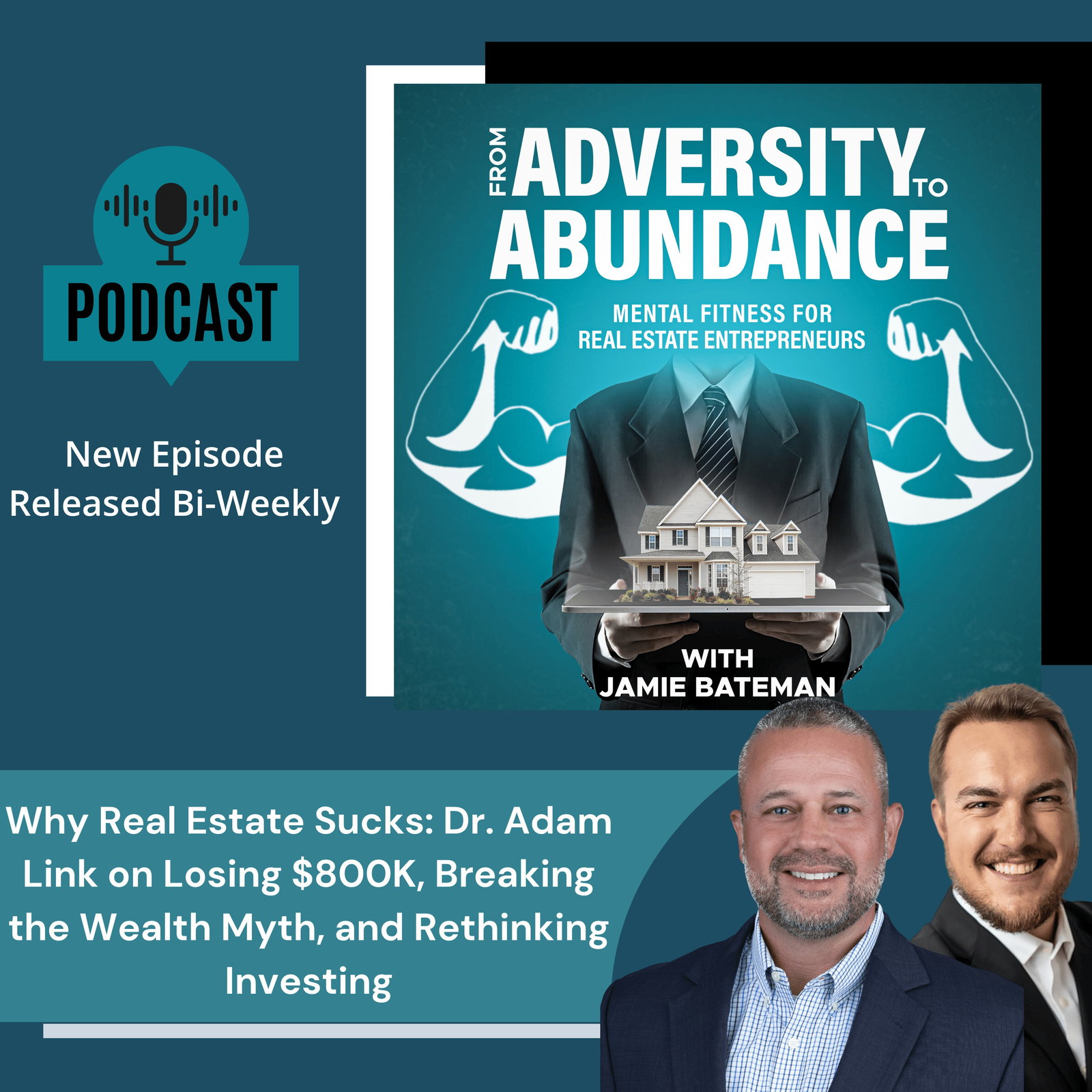
In this episode of From Adversity to Abundance, host Jamie Bateman sits down with Dr. Adam Link, certified financial planner and founder of Fireweed Capital, for a candid conversation about the realities of investing and building wealth. Adam shares his journey from post-2008 financial adversity to becoming a multimillionaire, including high-profile career roles at Coinbase and multiple entrepreneurial ventures. He dives into his personal investment challenges, having lost over $800,000 across various real estate deals—including syndications and fraud—offering hard-earned lessons for navigating risk and operational pitfalls in real estate.
Beyond real estate, Adam discusses the importance of identifying your investor avatar, understanding risk capacity versus risk tolerance, and aligning investments with personal financial goals. The episode also explores career pivots, salary negotiation strategies, and how leveraging both hands-on experience and professional expertise can support long-term wealth. With insights on AI in finance and practical guidance for tech professionals seeking wealth growth, this conversation blends inspiration with actionable advice for any investor looking to avoid costly mistakes and think critically about their financial journey.
Guest Introduction:
Dr. Adam Link
Dr. Adam Link is a certified financial planner and founder of Fireweed Capital. With experience in tech, finance, and entrepreneurship—including a key role at Coinbase—Adam has navigated both significant financial wins and losses. He is the author of Why Real Estate Sucks, sharing lessons learned from his $800,000 in investment setbacks, and works closely with clients, particularly tech professionals, to grow and manage wealth strategically.
Episode Highlights:
- From Adversity to Abundance – Dr. Adam Link shares his journey from post-2008 financial struggles to becoming a multimillionaire financial planner and founder of Fireweed Capital.
- High-Stakes Real Estate Lessons – He recounts losing $50,000 to fraud and $600,000 in a multifamily syndication, offering practical takeaways on due diligence and risk.
- Investor Avatar & Philosophy – Adam explains the importance of aligning investments with personal risk capacity versus risk tolerance, especially for tech professionals.
- Career & Wealth Insights – Discussion of career pivots, negotiation strategies, and how AI and hands-on portfolio management play into long-term wealth building.
Key Takeaways:
- Losses and setbacks are part of investing; learning from them is critical to long-term success.
- Choosing reliable partners and understanding operational risks is essential in real estate syndications.
- Identifying your investor avatar before choosing asset classes ensures strategy aligns with personal goals and risk capacity.
- Career moves, negotiation skills, and leveraging professional expertise complement investment strategies for building lasting wealth.
Learn More about Adam Link:
LinkedIn:
https://www.linkedin.com/in/adamlink/
Website:
https://fireweedcapital.com/
Company LinkedIn:
https://www.linkedin.com/company/fireweedcapital/
Learn More about Labrador Lending:
Integrity Income Fund:
labradorlending.com/passive-investors/
Labrador Mentorship:
labradorlending.com/active-investors/
Asset Management Service:
labradorlending.com/hybrid-investors/
—
Purchase Jamie’s Book: www.amazon.com/dp/B0CGTWJY1D?ref_=pe_3052080_397514860
—
Leave us a REVIEW: podcasts.apple.com/us/podcast/from-adversity-to-abundance/id1618672867?mt=2&ls=1
www.adversity2abundance.com/reviews/new/
Connect with us
Website: www.adversity2abundance.com
Facebook: www.facebook.com/labradorlending/
Instagram: www.instagram.com/labradorlendingllc/
LinkedIn www.linkedin.com/company/labrador-lending/?viewAsMember=true
Youtube: www.youtube.com/channel/UChYrpCUlqFYLy4HngRrmU9Q
Connect with Jamie
LinkedIn: www.linkedin.com/in/jamie-bateman-5359a811/
Twitter: twitter.com/batemanjames
Speaker 0
In this episode, you get to hear from doctor Adam Link. Adam is a certified financial planner. He comes from the tech and finance spaces, and, he wrote a book called Why Real Estate Sucks. We're gonna get into that. He's lost over eight hundred thousand dollars in real estate syndications. And he he really has a wealth of knowledge. Real I I thoroughly enjoyed this conversation. I think you're going to as well. You know, you should listen to this episode and learn from his lessons that he's learned, learn from his mistakes. I certainly chime in on some, some things as well. And I just love that that, you know, we talk about a good bit about the seasons in life, how life has seasons. There's not one path to success. He's gone back and forth between being a w two employee and being an entrepreneur. He's got a lot of financial abundance for sure, multimillionaire, and but he's got scars to prove it. And the journey is not over, and, you know, I I think you're really gonna enjoy this episode. There's a lot of lot of inspiration, but also a lot of practical guidance and a lot of value overall. Enjoy. Speaker 1
From adversity to abundance, hosted by entrepreneur and seasoned real estate investor, Jamie Bateman, is the ultimate guide for active and passive investors seeking clarity, mental fitness, and the confidence to make inspired decisions in the world of real estate. With a decade plus of investing experience across various niches and a background as a combat veteran, former army officer, and multimillion dollar mortgage note company owner, Jamie brings a wealth of knowledge and inspiring stories to each episode. Through weekly episodes featuring insightful interviews with industry leaders and solo explorations of mindset and strategy, listeners will uncover actionable advice and tips to overcome challenges and build lasting financial success. Whether you're a seasoned investor or just starting, from adversity to abundance is your road map to turning obstacles into opportunities and achieving financial freedom. Speaker 0
Welcome, everybody, to another episode of the From Adversity to Abundance podcast. I am your host, Jamie Bateman. And today, we have with us doctor Adam Link. Adam is a certified financial planner. Correct me if I'm wrong, Adam. And Yes, ma'am. Has a lot of investing experience in many different asset classes and some, potentially controversial opinions. We'll see where where the the episode goes. Adam, how are you doing today? Speaker 2
I'm doing very well. Yeah. As we record this on a Friday morning hearing, I got my cup of coffee with me and, ready to chat chat money, chat investments, and, chat investing. Speaker 0
I love it. Absolutely. Me too. I'm excited. This is gonna be good. For the listener who may not be familiar with you, Adam, who are you and what are you up to today? And what what is some of the abundance that you can touch on, the abundance that you've been able to experience possibly financially, that you're living in today? Speaker 2
Yeah. Certainly happy to. Yeah. So my name is, doctor Adam Link. As the doctor implies, I I have a doctorate. So I I learn best through formal education. So I got my doctorate in computer science, and then I I'm a certified financial planner, which means I help individuals to craft a plan to use their money to achieve the goals that they want. Specifically, I typically work with, tech folks and folks who are kind of up and coming on their wealth journey. I look for people who kind of look like I was maybe ten years ago, hungry, wanting to be a millionaire, wanting to, you know, accumulate capital. And that's that's usually who I enjoy working with because I I know that path. Right? I've lived that path, and I'm kind of on the other side of that path now where, you know, I can say things like the first million you make is the hardest million you'll make, and then the second million is easier, and the third million is even easier. And we can keep going. Right? But, you know, once you end up in that realm where you don't need to necessarily look at a receipt from a store pretty much ever again. Right? It's a really cool place to be. And one of the things that I've really enjoyed in my life is helping other people get to that place where I am, where, you know, you don't have to worry about the day to day. You know, most Americans are worried about a four hundred dollar unexpected expense, and I don't even know if a four hundred dollar expense would register for me. Right? You know? And and that's to say, you know, I've I've worked incredibly hard. I've gotten somewhat lucky, been in the right place at the right time many times, you know, but really hustled hustled a lot to get to where I am. You know, and now it's a question of, well, where do I wanna go from here? You know, how many more zeros do I wanna add after the net worth? And that's a really fun place to be, right, when you've reached your goal and it's just a question of, well, how big do I wanna get? Right? So yeah. That's yeah. Yeah. You you talk about abundance, man. I I don't know. I I feel like I've got a pretty good life. I've got a big well, biggish house on a lake. Got a boat. You know? Like, all the trappings is somebody who's been truly successful. Right? Speaker 0
Got it. Yeah. And then, it's it's just been smooth sailing and easy for you your entire life. Right? Speaker 2
Hundred percent. Never had any no. Totally kidding. Right? Yeah. There there were nights where I I stayed awake till three in the morning worried about, you know, the next day, worried about meetings, mental breakdowns, you name it. Right? Like, we we all face it. Speaker 0
Yeah. Yeah. So for the listener, just I mean, you know, we do try to provide a bit of a hook just being honest with people in the beginning of an episode to, point out some of the abundance that the guest, in this case, doctor Adam Link, is experiencing. But the reality is, you know, it's not easy to get there typically. And and, even if you were handed five million dollars, you've likely had some type type of adversity along the way. So, we're trying to trying to provide inspiration as well as practical value. So let's dive back into your backstory, Adam. You, I think you before we hit record, you mentioned to me that, right after college, you started to experience some some adversity. Why don't you talk about that for us? Speaker 2
Yeah. Certainly. So in college, I got my degree in finance. I then kind of throughout my career ended up switching between tech and finance. So my my story is really one of pursuing two paths simultaneously as often as I could. Coming out of college, I basically job hopped. I came out in twenty ten, so we were kind of on the back of the great financial crisis. You know, blocks of houses were going for a hundred bucks in Detroit. I didn't have a hundred bucks to my name or I would have bought, you know, blocks of houses. Speaker 2
So I basically came out, you know, of college deciding between eight dollar hamburger or nine dollar cheeseburger. You know, did I have an extra dollar in my bank account at that point in time? And really took whatever job I could get. I ended up working hourly, for a financial adviser and then switched over and worked in financial services for a while. Left that job because I wanted to start up a company because like everyone else, you know, being an entrepreneur is the way to insane wealth. Right. And so started up a company and, you know, that that went nowhere and then got another job and started right? So, like, you know, just kinda switched around where enough that my my grandfather asked my dad at one point, is Adam ever going to hold down an actual job? Right? And, like, you you gotta understand. My my my grandfather was a CEO of a pretty large company. Right? So, like, he was a CEO of Hardware Hang. So he he had had success in his own life. K. And he's like, is this guy you know, is he ever gonna do something in his life? Right. Well, luckily, the answer is yes. I basically ended up getting one of the startups that I was working on, with my my college roommate to succeed. We ended up selling that to a company that wanted to build a mobile application kinda studio. And so, you know, we were at the table for our first sale. And it wasn't a big one, but it was enough that, you know, we got to the table. We got to negotiate. We met a guy who actually was worth hundreds of millions of dollars. Mhmm. Speaker 2
know, so I had kind of my first brush with insane wealth. Right? Speaker 2
And really got a chance to work alongside that individual and his company for a a number of years as I kinda learned what the tech industry was. And, you know, then started up another company, sold that one. It's a second time at the table. Right? Again, not a huge exit bigger than the previous one. But, you know, getting to the table a couple times as an entrepreneur means you at least know what the term sheet looks like. Speaker 2
You know, and then from there, really end up working in the crypto space. This is kind of about eight eight, nine years ago now when I entered the crypto space. And, it was, you know, early on in in crypto, twenty seventeen, twenty sixteen. I ended up being hired as employee number one for a start up company. And that was kind of the third time I got to the table when we when we sold that company. And then that led me to, to working at Coinbase where I was a part of the IPO at Coinbase. Mhmm. And then leaving Coinbase to start, Firewood Capital. Because I basically realized all along that time when I was doing tech, I was also giving financial advice to all my coworkers. Like Right. Here's how you do four zero one k investing. Here's how you think about, you know, buying houses. I was like, I should get paid for that. So I, I decided to go become a licensed financial adviser, go back to kind of my my first love of finance, and, that's what I'm doing now. Speaker 0
Nice. Yeah. I love the fact that, you know, one of the things I tend to point out, you know, in different episodes is that there's not one path to financial freedom. There's not one, you know, way to do this whole investing or or financial planning thing. And we definitely don't I don't view it as, oh, you should be an employee for fifteen years, and then you should quit your w two and become an entrepreneur. You know, I like to talk about life having seasons and, yeah, you can have an idea of where you're headed, and you should you you should have some goals and some, you know, something you you're trying to aspire to do and be. But things change, and your your passions change, and market conditions change, and you gotta work with the circumstances around you. And there's nothing wrong with a a pivot. So sounds like you've had numerous pivots over the years Speaker 0
And a lot of different seasons in your life, and, it hasn't been a straight line to success. And I also love just the the the tech real estate crossover because I think that's obviously a big big thing right now for sure. And then the just the personal finance angle has has always appealed to me as well. But, so okay. So I guess looking back at your career, what would you say were some of the inflection points? The biggest you mentioned come getting to the table three times, and those were three big successes. Would you say those were kind of the big big, inflection points from a success standpoint, or were there others along the way? Speaker 2
Yeah. So I think everything that you do in life is kind of, you know, training for the next thing. Right? And so getting to the table once, you know, kind of meant it meant the second time I was at the table selling a company. It wasn't like, oh my gosh. I'm selling a company. It was like, okay. This is like I've been here before. It's slightly different. But the, like, the coolness factor has worn off. Mhmm. Speaker 2
so you're able to just deal a little bit less emotionally. Sure. Right? And so every time you do something, you know, the next time you do it, it's a little bit less emotional, a little bit more logical. Speaker 2
I would say when I think about kind of inflection points, one of the things I did early on, I think was really helpful, was make outrageous demands for salary. Okay. I went through a period in my life over about six years where every two years or so, I doubled my salary. Wow. Yeah. Which which tells me I was probably underpaid. Speaker 0
Underpaid initially. Yeah. Speaker 2
Yeah. For some of that. But Right. You know, I I I basically through asking outrageous demands and and job hopping, you know, every time someone asks, well, what's what's the salary you want? I would say double the previous salary. And the crazy thing is I hit enough yeses that I was able to land that. Now it's not to say, like, I had three interviews, and I doubled my salary each time. Like, no. I I said that a lot of times and got a lot of no's and a lot of no. That's not possible. And right? But all you need is one yes. Right. And then all of a sudden, you go from, you know, a a life where you think fifty thousand dollars a year is a ton of money to a life where you're making over a hundred thousand dollars. Well, over a hundred thousand. Right? And, like, that's just a fundamentally different place to be. And now you've got a high watermark that when you go to your next job, right, they're like, oh, we'll pay you this. You're like, okay. Well, no. My my base salary is, you know, two hundred thousand. My base salary is three hundred thousand. Speaker 2
There was there was one point after Coinbase's IPO that a recruiter tried to hire me away. And I basically said, okay. Here's my comp package. Can you match it? And the guy looked at it and he goes, there is no way anyone needs to match this comp package. And I was like, well, then I guess a lot for yeah. Yeah. I guess you're not hiring. Right? Right. And it was just, you know, like, yeah. Well, here's a giant number. Right? And and the reality is that giant number is real for a lot of people in tech. Speaker 2
You know, you hear about these ten, twenty million dollar packages that folks in AI are getting. Like, that comes from somewhere. Yeah. Right? And it does happen to somebody. Speaker 0
Right? Sure. Now we focused a good bit of on your successes thus far, intentionally, but I know you've lost money with different investments along the way and a good bit of money. So let's talk about really some of that financial adversity with specific investment choices and maybe some things you would do differently. I know you wrote a book, a couple of books, one of which is entitled, I I think it's Why Real Estate Sucks. Is that is that right? Speaker 2
That is correct. Speaker 0
Let's talk about that. Let's talk about that book, and let's talk about why you wrote that book. We're, you know, we're I'm a real estate investor. We do single family residential. We we buy mortgage notes. I also have some rental properties. I'm a big residential real estate, not not huge, but I'm a fan of residential real estate investing in general where it fits. But what are some what's you know, what are some of the losses you've experienced in real estate or other asset classes? Speaker 2
Yeah. I'm certainly happy to talk about that. So the the book Why Real Estate Sucks is really based on my own personal experiences in real estate. And, of course, you know, the book is called Why Real Estate Sucks, so I don't include the ones where, like, the deal went well, obviously. Right? Right. Because I what I wanna do is I really wanted to highlight what actually happens in real estate, both the good and the bad. You know? I don't know if you guys will have a video for this or not, but behind me, I've got a whole bunch of books. And, there's a whole section of my books over here, which is basically how to invest in real estate. I got the bigger pockets books. I got the Grant Cardone books. You know, I've got, like, all the major books. I followed all the people on Facebook. I got pretty deep into real estate. I'd say this was about four years ago. Okay. And, like, many people probably listening, you know, thought, okay. Well, real estate's the way to become a millionaire and passive income. And, you know, just kinda fundamentally changed my life. So I started out with this goal of I wanted to be at six thousand doors by the age of forty Okay. Which is a huge goal. Right? And, you know, I I don't do anything small. Right? Because you're gonna do something like go go big. And so, you know, I started acquiring doors. And I I started basically, you know, as an LP on a couple deals and then working my way up to eventually being a GP and a KP on a deal. So I had, you know, a couple hundred doors under me. Speaker 0
And just just quickly, just for the Yeah. For those who may not be familiar, LP is limited partner. GP is a general partner where you're running the show. Basically, you're the operator. Right? LP is your your passive investor. And KP, that's a key principle or, key partner where you're you're basically they're kinda borrowing your your name in a sense or tell tell me what that is. Speaker 2
Yeah. Yeah. So it it's kind of, the progression that you end up doing. So limited partner is here's my money. I'm just along for the ride. Let's see what happens. Yeah. General partner is I have an equity stake in the deal that I've either bought or I've earned, and in some way, shape, or form, I am controlling a part of the deal. Right. Right? I I'm responsible. I'm somewhere in management. Yeah. And a KP or key partner is somebody who signs on the loan. So you are fudging your assets against the debt that is being taken out to purchase this real estate. And so a key partner, is really where where the, I'd say, the big dogs play. Right? Right. These are the guys with money. Right? You gotta have money and you gotta have experience to be a KP. Yeah. You need one or the other. So I I I brought the money, not the experience. I had a guy that brought the experience, and then, you know, I held on for two years as a key partner. Mhmm. And now most banks would take me as a key partner signing solo, because I have two years of operating experience. Right? So that's kind of
Speaker 0
Yeah. That's a great overview. Yeah.
Speaker 2
Yep. Yeah. I I I punched my key partner card. That is a big thing in the real estate. It's gonna go into real estate syndications. You know, you wanna be able to say, yeah. I can also be a KP. I can sign up a debt.
Speaker 0
Absolutely. Okay. That was a good overview. Thank you. So where did things go wrong for you?
Speaker 2
Yeah. Well, let's talk about one deal, which I I'm not gonna say the individual I invest with Mhmm. For multiple reasons. One being they're currently under FBI investigation, which tells you how that deal landed. Mhmm. But there's a lot of fraud and a lot of people out there who are willing to take your money and do very unscrupulous things.
Speaker 0
It's unbelievable. I just absolutely. Go ahead.
Speaker 2
Yeah. So yeah. You know, if if you know real estate, I mean, numbers like fifteen percent returns, eighteen percent IRR, you know, these numbers are not ridiculous. When you look at the stock market, an eighteen percent return in the stock market is a very, very good year.
Speaker 0
Sure. Right? Absolutely.
Speaker 2
Whereas, you know, eighteen percent is kind of par for the course in real estate. Yeah. So early on in my real estate investing career, I, basically, got to know an individual who was raising money for a real estate fund and had a a side deal. And, basically, the side deal was, you know, look. You give me fifty grand, I'll give you back ten percent returns after a year. And I thought, okay. Well, ten percent return in real estate is not ridiculous. Right? It's right in line with a senior debt position on Absolutely. You know? Right? And looking at the deal terms, you know, it was basically, look. If I don't pay you it was kind of a a double collateral backed note. It was, okay. Well, here's what I'm buying. Right? And if this doesn't, you know, work out, here's here's a stake in another building that I'd give you. And if that doesn't work out, here's a stake in my fund.
Speaker 2
was like, okay. Well, look. I I've got a pretty good fallback position here. Right? If this guy doesn't pay me, like, I can probably go after his assets. And if nothing else, I roll it over to an equity stake in this fund. Well, this guy didn't pay me. You know, basically, the due date for the note came and went, and we, you know, every time I contact him, it's the same thing. You know, hey. Payment's coming. Hey. Had a problem with refinancing of property. Hey. You know, all these excuses. Right. After about ninety days, I basically said, okay. Well, I'm pretty sure he's got my money. He's not. Right. And it took me a little bit, you know, just kind of trying to collect the the debt, and I got a paper trail. And then I talked to my CPA, and I said, look. I'm not getting this money back. Let's write off the investment. Mhmm.
Speaker 2
So, you know, fifty thousand dollars out the window. That's done. It's an expensive lesson to learn. Mhmm. This individual defrauded people for over four million dollars. Wow. Yep, is going through bankruptcy and is under investigation. You know, so there is a long arc of karma in the universe, but, you know, that was that was kinda one of the things that you just go there and you go, okay. Well, it's fifty thousand dollars I'm never gonna see again. And that, you know, it it sucked. I went back and looked at the decks and looked at the documents and tried to figure out, you know, whether signs that I missed. Right. And, you know, honestly, more due diligence may have turned up something. Like, man, that deal, it just seems so reasonable. Right. You know?
Speaker 0
Yeah. No. I hear what you're saying. It's it's I don't know if we're not gonna make this an episode about me and but, I it's very easy to beat yourself up after the fact for sure, you know, and say, well, here's something I should have caught. It's like, well but it made sense at the time. I mean and you you you know? I'll just speak for myself. Yes. There are deals where I should have done a better job evaluating the person I invested with. That's typically number one. And, you know, or the deal itself and or but the reality is, you know, you can do everything right from a due diligence standpoint, and the deal can go way wrong. And, you know, fraud is a whole separate I mean, that's, you know, difficult to spot, I mean, before it occurs. Right? So, I've been the victim of a pretty big PPP loan fraud scheme. And in fact, they're the it's years later now, but it's being prosecuted. There was a huge ten person, you know, collaborative scheme going on, and I I had to, you know, I I got letters from the IRS saying I owed a hundred and five thousand dollars because I'd, apparently had twelve employees that I, you know, with and I'd taken out a ninety some thousand dollar PPP loan. None of this was true at all, and someone had, you know, stolen my identity and and, gotten a PPP loan, you know, wired the the day after the application was submitted. They didn't look anything like me. They opened up a fake bank account, and I had to close a business, move some rentals over to the new business. It was a lot of stress, and and, financially, there wasn't a huge loss to me personally. It's actually the US taxpayer who was ripped off. But there was but I I've experienced some of the things you're talking about, and it's like, I don't know. What what did I do it? Would I do things differently? I mean, I I could have been a little more proactive in certain ways, but I really don't feel like I did anything majorly wrong in that case. I just was in the wrong place at the wrong time. So, again, not trying to make it an episode about me. I I can just relate in some ways in in you know, there's a lot real estate in general is fairly unregulated, real estate investing. I mean, when you get into funds and things, there's the SEC and certain state regulators and whatnot. But, it's there's a lot of the wild, wild west going on out there, especially in we do mortgage notes. And, I mean, you know, it's it's a pretty low barrier to entry in our space and and, you know, which can be a good thing because people can jump in and do well and and make money. But it it invites a lot of unscrupulous people. And so we try to kinda police our own in our industry, because there's a lot of fraud out there and a lot of people I just don't know how people can sleep at night after doing what they do. Some of these people. Most people, I don't think are that way. But, anyway, so what happened in in in your case?
Speaker 2
Yeah. So, I mean, in this case, you know, I ended up writing off the Yeah. Investment, which I I I will say, as you gain wealth, the team you have around you is incredibly important. Obviously, I'm a financial adviser, so I think you should have a financial adviser. I will also tell you if you're going off the beaten path, get a really good CPA. You know, like, the number of times my CGA has saved my butt because he looked at, you know, a deal a slightly different way. And he goes, oh, actually, you got this capital gain over here. You write off that capital loss. You net them together, and there you go. Right? And it's like, okay. Cool. You know, I I so a good CPA who knows the tax code can really help you out when, you know, when you have these financial losses because the thing is, you know, the government wants people to take risk. Right? The government tax code is written for the business owner, for the entrepreneur. And there's risk, and you lose money. And the government basically recognizes Yeah. If you lose money that, you you know, they should do something nice for you. Right? And so there's there's a lot of incentives for when you do have a deal go south that you can really capture that and and bring it forward to offset future wins. So that's actually you know, we'll we'll talk about the the second Yeah. Big misadventure, which was
Speaker 2
The, being a GP and a KP on a, deal. It was about a three million dollar deal. And, I will say everything seems to look good on paper. Right? And this is how deals often are. Right? It looks good on paper. And I will say I had a great group of investors on this one. We were basically, I should say, partners on this one. We set it up as a as a joint venture with the idea basically being that we were all gonna try to learn what we could, by purchasing a larger property. And the goal was really to help get some of us to become key partners Mhmm. And then, you know, learn operations. Right? And the where the deal basically ended up falling apart was when the market shifted on us, rents were not able to, increase as much as we thought.
Speaker 0
Just a multifamily syndication?
Speaker 2
Yep. Multifamily syndication. Yep. And we did not have a property manager that was going to work with the deal structure we had put together. Okay. So we we ended up going to two property managers in the span of, you know, a couple years, which is a fairly, I I'd say, high churn, but also not abnormal. Right? There's a lot of deals you get in with the first property managers out after about the first year because it's just not a fit. Right? I I've seen deals like that as an LP, and you just go, okay. Well, whatever. Right? Like, I get your brain into Right.
Speaker 0
It's not a huge red red flag that there's something wrong with the deal. I I agree.
Speaker 2
Yep. Yeah. Exactly. Where where we ended up getting kind of, screwed over on the deal by the property manager, was they they actually negotiated better on the contract. Okay. Yep. And they, you know, slipped in a a common cause for property management, which is, you know, they're gonna get paid, you know, ten to fifteen percent on, jobs they have to do. And we took that to mean construction. Right? So, like, if we are adding on something big, they get ten to fifteen percent.
Speaker 2
The way that they were interpreting it was every call out, every name. Management. Yeah. Everything. Fifteen percent. You answer the phone, fifteen percent. Your call out fee plus fifteen percent. Your fee plus fifteen. Right? It was like, wow. And and so we didn't realize the impact of that until probably about six months in to having this new property manager. And we were just looking at our entire margin going out the door to them. Wow. Right? And so we basically ended up at this situation where the deal wasn't cash flowing. We couldn't increase rents, you know, to offset what was happening. The market was going soft around us. Right. And, we actually ended up getting the loan from the bank, out of a distressed asset situation because the previous owners had owned it during COVID, and they were forbearance, you know, due to the the just the real estate market during COVID going completely upside down. People couldn't be evicted. Nobody paid. And so we ended up with an asset that was barely cash flowing more often than not in the red. And after a capital call to try to turn it around, we all just sat down and said, look. This thing is not turning around. We gotta sell. And, we all took a hit. You know, we all took a hit. I I took a pretty big hit as the, the main key partner, as the main GP, as the guy who was kind of leading the charge to get this deal to happen. You know, I I really put my own money on the line instead of my partners, right, and really tried to cover them as much as I could. So, you know, they
Speaker 0
How much did you lose, if you don't mind? Yeah.
Speaker 2
Yeah. That one that one, I lost about six hundred thousand six, seven hundred thousand dollars on that one.
Speaker 2
Stings. Yep. Yep. Yeah. And and, again, the the range is kind of, well, what do you consider losing it? You know, I over the course of the years, right, put in money that I'm not getting back. And, yeah, it does sting. Right. But at the same time, I look at the partners in the deal, and while we all lost money Mhmm. You know, they walked out with more of a shirt than I had. And I think that, you know, if you're going to invest in real estate, what you wanna see is a story like that. You know, when did you, as the lead, take the hit to protect everyone else? Right. Right? And if they can't point to it, you're investing with somebody who doesn't have enough money to do that. That's a scary place to be because they're gonna cut and run. Right? That's that's
Speaker 0
so so yeah. So on that point, just for an investor, maybe, whether LP, GP, but what's what's the advice you would give someone about that? You're you're saying that the the key, KP doesn't have enough money, you shouldn't partner with them, or what exactly is the the advice there?
Speaker 2
Yeah. So when you look at the way a real estate deal comes together, someone has to have money in the deal. The bank wants to see that someone has enough money or net worth to cover the loan that they're going to give to the syndication, to the group. Right. So that means that someone someone somewhere in the deal has money. And what you wanna make sure of is that you are somewhere between the bank and that person with money.
Speaker 2
And that's not always the case. So one deal that I was looking at, I happen to know some of the key partners. I mean, one of the key partners who was signing didn't have a giant balance sheet but had the operational experience, and they were gonna be the operator. And the key partner who was signing who had the giant balance sheet, I knew was not going to be a primary operator. Okay. Right? And so what that meant was when things went or if things went south Right. Right. Right? The operator didn't have their own skin in the game. Mhmm. And they were more than likely to sell at a loss and basically toss the syndication group aside Mhmm. To protect their other key partner who actually had the balance sheet. Right? Because somebody's gotta pay the bank back.
Speaker 2
Right? And when you have equity in a deal, if you sell for the value of the loan, you are probably going to sell for less than the asset is worth. And so somebody takes a hit, and that somebody is the investor group. Right? Now the way you want it to be is somebody takes a hit that somebody is the person with the biggest balance sheet. Right? If you're investing with an established, GP, they can throw their balance sheet in front of the investors and take the first hit so people walk away with some of their money. Right? And that that's a GPU values their investor base because they wanna come back to you for the next deal and the deal after that.
Speaker 0
It's a long longer term view first yep. Exactly. Relationship, long term. Absolutely.
Speaker 2
Yep. What you'll see with a lot of the the newer GPs that implode Yeah. Is they're, you know, signing these deals, and they don't have the balance sheet to protect their investors. And so when the deal goes south, they just sell the asset for what they can pay off the loan, and they don't care that their investors lost money.
Speaker 2
So that's that's where you don't wanna be as an LP because you are the person who gets tossed in the fire. And that's Right. That's not where you wanna be as an investment. Speaker 0
Yeah. So let's pivot a little bit. And and, I mean, I know we briefly touched on your book. So what is it about real estate that sucks? And we talked about your personal experiences and some of the things that went really poorly, but what is it that you don't like about real estate? And I understand you're you know, there are things things good about real estate. I I put out content about why you should not invest in mortgage notes, and I do mortgage notes, you know, full time. So there's no perfect asset class, and there I think we did a blog post that was ten reasons not to invest in mortgage notes. And, so but, what is it about real estate that sucks, and what are some other maybe more controversial views that you might have in the personal finance or or investing space? Speaker 2
Yeah. So one of the things that I I highlight in my book is basically, you know, outside of losing money, there's operational stuff that people don't necessarily see covered in these other real estate investing books. One of the big ones is when you join a syndication, you get a k one. Most people don't realize that a k one is technically due in March, which is before your taxes are due. Speaker 2
However March is the main exactly. Yep. Many small syndications will not get you a k one on time. And so you are signing up for extending your tax returns for every year that you were in the partnership, because you cannot get out of the partnership. And if you've got a partnership that is perpetually late on k ones, like, I Which is very common. Yep. I have enough partnerships that one of them is always late. Speaker 2
You extend your taxes. Right? You extend when you get your return in. And the thing is your taxes are still due April fifteenth even if your return is not complete, even if you're filing for an extension. Speaker 2
Right. And so you end up in this position where your tax your tax life basically is never done in April fifteenth. Speaker 2
And that is just something that, for me, I don't like because then I get billed more by my CPA for extending and then Yeah. Absolutely. You can't close out the previous year mentally in September sometimes. Speaker 0
Yeah. And it it it was April fifteenth. I'm I'm almost certain years ago. It was actually April fifteenth that the k ones were due, and a lot of people, syndications and funds were late still. And regardless, like, by April fifteenth, you could not file your taxes, but you had to pay your taxes like you're saying. So I've been in that I'm in in that position now, actually. I mean, a lot of it is very common for k ones not to be put out on time. I can say we've with our fund, every year, put out our k ones on time, which is good. But, that's that is something that sucks about real estate. I would agree with that for sure. Speaker 0
Yeah. Yeah. It's What else? Speaker 2
Yeah. It's it's something I I see a lot of, you know, like, doctors especially try to get into real estate because it's been massive. Speaker 2
And, you know, when when you're a doctor, you're already busy enough. And now you got a k one that's gonna show up in August. Right? It's like, hey. Guess what? Your taxes gotta get reopened because you never finished that. Right? And so it's just it's just the mental headspace of, like, there and and and no passive real estate investment is ever passive. If you're an NLP, technically, legally, it's supposed to be passive. But the minute you start buying passive real estate, like, you buy a single family home and you're like, oh, it's gonna be passive. It's not passive. Right? Yeah. And I I tell you that as somebody who owned passive real estate, and I was up on the roof of my passive real estate. Right? Like, you you if you're on the roof of your real estate investment, that is not passive. Speaker 0
No. I would agree. I mean and and don't wanna get sidetracked. I've I've done, we we do put we put out some content about I think last year for the cash flow expo, I did a thing about, presentation about kind of the spectrum of passiveness. And, you know, I would say our fund for we invest in first lien mortgage notes. We do monthly distributions. It's about as passive as you can get. I mean, ultimately, it's like, where's my where's my I wanna check and make sure my my, deposit occurred, and where's my k one? And, you know, some people are a little more hands on than others. Some of our our investors. That's about as passive as you can get in this space from my, you know, standpoint. But there's a huge spectrum in between, and there are a lot of ways whether it's through joint ventures, selling partials, doing hypothetications, buying, you know I mean, buying a couple performing loans is is is not super active. But people love gurus love in our space to say active and passive or performing and nonperforming. And it's like there's a huge gray area that's really the majority of of experiences in reality. And so, I would agree in most and and there's you can get pretty close to passive, and then there's the other extreme of of really active and managing a fund and and things like that. So, yeah, I mean, what what a lot of people are sold is not the reality. That's I I would I would agree with that for sure. So, and and, I mean, I was I was really into listening to BiggerPockets and reading the books as well and, you know, owning a bunch of single family rental properties is very far from passive even if you have a a good property manager. I mean, that's not passive investing at all. It may be treated that way from a tax standpoint, but it's it's not passive. So, yeah, so the hundred percent agree. So what what would you say is passive? I guess, would you say investing in stocks and crypto is is passive, or are there passive asset classes out there? Speaker 2
Yeah. So the way that we run our wealth management practice here is we we try to be, as hands on as we can so our clients can live their lives. Right? And that's kind of when you look at passive investing, I I truly believe that you should never be a passive investor. Right? You should always know what you're buying. You should know why you're buying it. You should know what it does for your portfolio. Now you outsource a lot of the thinking oftentimes to professionals. Right? For instance, you know, you know why you have real estate in your portfolio. Yeah. They can tell you what percent of your portfolio is at real estate, what your value at risk is, what that does right to your portfolio in various, you know, market scenarios. Like, that's my job. Right? My job is to go through all that nitty gritty stuff and kinda say, okay. Well, here's what you got, and here's how it ebbs and flows. Right? But if you just go, look. I yeah. I've got these stocks, and I've got these bonds, and I've got this real estate, and I know roughly why each of them helps me go to Disney World every year. That's what you need to know. Right? That's what you need to know. You know, or I I know why I'm investing in this portfolio because it's going to get me another million dollars. Right? That is, like, that is what you should know, and you should have an understanding of why you're building the portfolio the way you are. But then, really, hiring professionals to manage those investments, I think, is the right move because someone has to look at your portfolio every day. Someone has to understand Yeah. What the jobs report means for your holdings. And if that's you and you've got a day job, that means you're spending your weekend reviewing economic data. And while that's fun for me, this is my job, I can almost guarantee that most of my clients would rather spend that time with their family or, you know, out exercising or out on the lake. And, really, what you're buying at that point is, you know, you're buying your weekend. Right. You're paying a professional so you don't have to do it yourself. Speaker 0
Makes a lot of sense. So we we are starting to run out of time here. So do you, is there any kind of general guidance for, you know, percent of, someone's portfolio that that they should have real estate, or is that completely clients, specific? Speaker 2
So I I will say it's usually very client specific as to what your risk capacity is Yeah. And your risk profile is. Yeah. I think Jamie and I talked about this earlier, before we started recording, which is, you know, your investor, persona. Right. Your investor profile. Speaker 2
And that is one of the biggest things. You know, for me, when I look at that deal that I did in real estate Yeah. We lost money because we were not dealing with, really, tenants and an environment that I was used to dealing with. Right. I don't invest in mobile home parks because, quite frankly, I don't have anything in common with folks in mobile home parks, and that is not I I deal with folks who are generally college educated with advanced degrees. I just don't know how to deal with Speaker 2
The tenants of mobile home parks. And as a result of that, I don't know how to evaluate the deal. I don't know how to get involved in that, and so I just don't put my money there. Speaker 0
Right. No. It's and it's not that you're putting those people down or something. It's just that you you you're understanding your own investor avatar and your own self. Know thyself. Right? And I second time I've referred to this cash flow expo, but a couple months ago, I did a presentation about knowing your investor avatar first instead of just jumping into an asset class that somebody else is doing and it looks sexy. I couldn't agree more. I mean, that's, like, that's so critical. I've made that mistake myself. It's not really understanding who I am from an investor standpoint and what I'm trying to accomplish. I'm more focused on this sexy deal, and oftentimes, that doesn't doesn't go well. So Yeah. Make makes sense. Yeah. What's one other, kind of maybe, you know, key piece of guidance that you give your clients, if you would? Is is there any kind of framework that fits to to, for everyone, or is it is everything client specific? Speaker 2
Yeah. Let let's kinda just paint some broad strokes on on advice that I give folks. Yeah. So the the first one of them is kind of risk capacity and risk tolerance. Okay. These are two separate things. Most of the time, we talk about risk tolerance. Right? If this investment goes up ten percent or down twenty percent, which one would you rather have? K. That's very different from risk capacity. Risk capacity is how much of a hit can your balance sheet take in dollar terms Okay. Or there's a problem. K. If you're worth a hundred million dollars, your risk capacity is probably in the millions. You can probably lose ten million dollars in a single year and not care. Now your risk tolerance may be very different. Right? You may be one of those people that you worked your entire life for that hundred million dollars Yeah. And this is it. This is you have now made it. You got dynastic wealth for your family. That is what you wanted. Losing a million dollars would be catastrophic to you mentally. So So even though you can lose ten million Speaker 2
Right, you if you don't deal with someone who recognizes the two together, you might end up in a situation where your financial advisor is saying, well, you're fine, and you're going, no, but I'm staying up in it. Speaker 0
Yeah. So so risk tolerance is a little more emotional slash, you know, individually, you know, mentally specific, if that makes sense. Risk capacity is a little more objective, logical from a third party standpoint. Is that is that fair? Speaker 2
Exactly. Yeah. And you see this in real estate all the time, people who are growing their empire. Your risk tolerance is high. You are willing to take wipe out risk. Your risk capacity is very low because you have to put food on the table for your family. Speaker 0
Right. Right. Right. That's a great point. I hadn't I hadn't really thought of it like that. I I like that. Awesome. Well, before we hit some rapid fire questions, any other kind of, general guidance that you like to give people? Speaker 2
Yeah. Start early. Whatever you're gonna do, whatever you're doing for investing, get started get started early even if it's not perfect. Because, if you look at a thirty year investing horizon, the last three years grow your money more than the first ten years combined Wow. In many cases. Yep. So just get started. Doesn't matter what it is. Just get get going. Speaker 0
Alright. So I have a few questions I ask, almost every guest, but one more before we get to those. You you're a tech slash, you know, finance slash, you know, investing guy. So where do you see AI? How is that gonna disrupt our entire our environment from a career standpoint, investing standpoint? Nobody knows a hundred percent. We know that. But what's your best guess as to are are accountants gonna be a thing in three years? Are attorneys out of business? What are things gonna look like in a couple years from an because of AI? Speaker 2
Yes. I think the basics are gonna be covered by AI very easily. In my own profession, I have talked to AI about things that are complex, like Roth conversions. AI has gotten Roth conversions wrong. So if you're about to move a hundred thousand dollars in a Roth conversion and take a tax bill, come talk to me because I tried to do this with AI, and AI was like, oh, yeah. No. These are equivalent. I'm like, well, you forgot to pay taxes. It's like, oh, yeah. You're right. I totally forgot to pay taxes. It's like, well, okay. That's why you talk to an ex. Right? But it never fully Speaker 0
admits its mistakes. That's the thing that gets me. But anyway Exactly. Speaker 2
You're exactly right. I totally missed that. It's like, well, great. But I want a little bit more contrition out of you. Yes. Yes. So for complex stuff, the expert is still the best way to go. Sure. Especially things where you may end up on a litigation docket. Speaker 2
Because at the end of the day, AI is still not in the courts, and court cases are basically humans talking about opinions and deciding which one is right. And that's where you want a human to be involved because a computer doesn't understand opinions and shades of being correct. At the same time, if you are not using AI yet in your own practice and your own job, whatever that is, get on it. It is huge. It allows me to punch well above my weight as a small firm. I can do the work of of probably, you know, twenty person marketing department with one AI chat. That's amazing. Right? So that's it's a huge tool. It's a huge tool. Speaker 0
Yeah. Makes a lot of sense. Like everything, you know, or most things, there's there are pros and cons, and so it makes a lot of sense. Some rapid fire questions for you. You've already touched on this, but briefly, how has financial abundance made your life better? Speaker 2
I don't have to sweat the small stuff, and I get to think big. Right? I have the resources where if I see something in my community that I wanna change, I actually have the connections and the balance sheet to go be the person to change it. I can't change everything. But if I care enough, I can be the guy leaving the charge. And that's a really cool thing to do. Speaker 0
That is really cool. That's really good. What is a book or two that you can recommend for my listener? Speaker 2
Oh, that's good. Alright. I will actually take one of these books on my shelf here. It's called the the first tycoon. It's about Cornelius Vanderbilt. I've recommended this book before. I think there's a lot of knowledge to be gained by studying the origin stories of wealthy individuals. Cornelius Vanderbilt was one of the first very wealthy individuals. Same thing you can go with Andrew Carnegie or Rockefeller. But, really, in those books, when you read them, read the first few chapters very, very thoroughly because what you wanna learn is how they do their first deal. It's not about the deal at the end that they made when they were fifty, sixty, eighty. Right? That's what you're gonna get, but how you get there is that first deal. And that's so that's what I I recommend people read those origin stories. Find that first deal. Find how they start. Speaker 0
Start. Makes sense. Yeah. I've heard, I mean, we all like to quote Warren Buffett these days, but, you know, what he's doing now is pretty different from what he was doing thirty, forty years ago. So what's one question that you wish I'd asked that I I did not ask? Speaker 2
Oh, that's good. What's what's my investing philosophy? Speaker 0
What is your investing Speaker 2
philosophy, doctor Adam White? Yes. Yes. So this this is something that, my clients and I talk about all the time. It is philosophical fit with your financial adviser. I believe that you can look at markets and you can navigate through public stock markets. A lot of people call this active risk management. A lot of people confuse it with active management. But, basically, what we are doing is we are taking positions in the market, and we are not just buying index funds and holding for thirty years. We truly believe that you can better position your portfolio based on macroeconomic factors. And that is something that a lot of people in financial advising industry say, well, you don't outperform the market when you do that. Right. Speaker 0
You hear that all the time. Speaker 2
That is one hundred percent right. I'm not trying to outperform the market. I'm trying to do a little bit better than the market does when we lose money, and I'm trying to get as much of the upside as I can when the market makes money. And what that looks like is a smoother ride for my clients. When you don't lose as much, you're gonna gain as much. Right? But that's really what we're looking for is Okay. Yeah. Stop stressing other clients. Speaker 0
So a little less volatility. Right? Sounds like Exactly. Got it. Awesome. Well, doctor Adam Link, where can our listeners find you online? Speaker 2
Yes. You can go to fireweed capital dot com. That is our online website. You can also email me directly adam at fireweed capital dot com. I love to talk finance, real estate, tech. You know, and, obviously, if you set up a time to chat chat with me, the the first meeting is always free. Usually, Usually, the first couple meetings where it's getting to know each other, see if it's a good fit. So if that sounds like something, you know, your listeners wanna do, by all means, awesome. Reach out. Speaker 0
And your typical client, Avatar, you already touched on this, but just reiterate, who who do you often work with? Speaker 2
Yeah. So I often work with, tech families. I've got a family, so I work very well with parents. And the biggest thing that I love is I love clients who are striving to become more. If you've got ten thousand dollars and you wanna be worth ten million, let's talk. Let's talk. I mean, that's that's awesome. I I love getting on phone calls to people who are striving to better themselves and better their financial situation because I get jazzed up by that. Absolutely. To help people. Speaker 0
Yeah. I couldn't agree more. And that's one of the things I love about this, My my podcast, honestly, is that it fires me up, and and we talk about taking ownership of your financial situation, your health, and different things, just taking ownership of your situation. I do some mentorship in mortgage note investing, and then the people I end up loving, you know, to work with are those who take ownership, and they're fired up, and they wanna because I I it's up to you. You know? It's not up to me to do the work and to so I, I hear what you're saying there, so that's great. Didn't mean to to take it back about about me, but, Adam, this has been really, really great. I I feel like we should have you on again. You clearly are a wealth of knowledge, and, you've, you know, done really well for sure, but that you've had your share of, cuts and bruises and challenges along the way. So any final thoughts that you wanna share with our listeners? Speaker 2
Yeah. There's there is no end to having enough money, and so you gotta decide where enough is. For me, I want another zero. I'm not done yet. I wanna keep growing. So Awesome. Reach out, and, I I wanna grow alongside those that wanna grow. Speaker 0
Perfect. Well, thank you so much for your time. Appreciate it. Likewise, Jamie. Thank you so much. Absolutely. And to the listener, thank you for spending your most valuable resource with us, and that is your time. Thanks, everyone. Take care. Speaker 1
Thank you for joining us on From Adversity to Abundance. We hope today's episode has equipped you with valuable insights and practical advice to elevate your real estate journey. For more inspiring stories and resources, visit us at w w w dot adversity to abundance dot com. If this episode has inspired you, please share it with a friend who could also benefit from our conversation. Together, let's turn adversity into abundance. Until next time, keep building your mental fitness and your real estate empire.