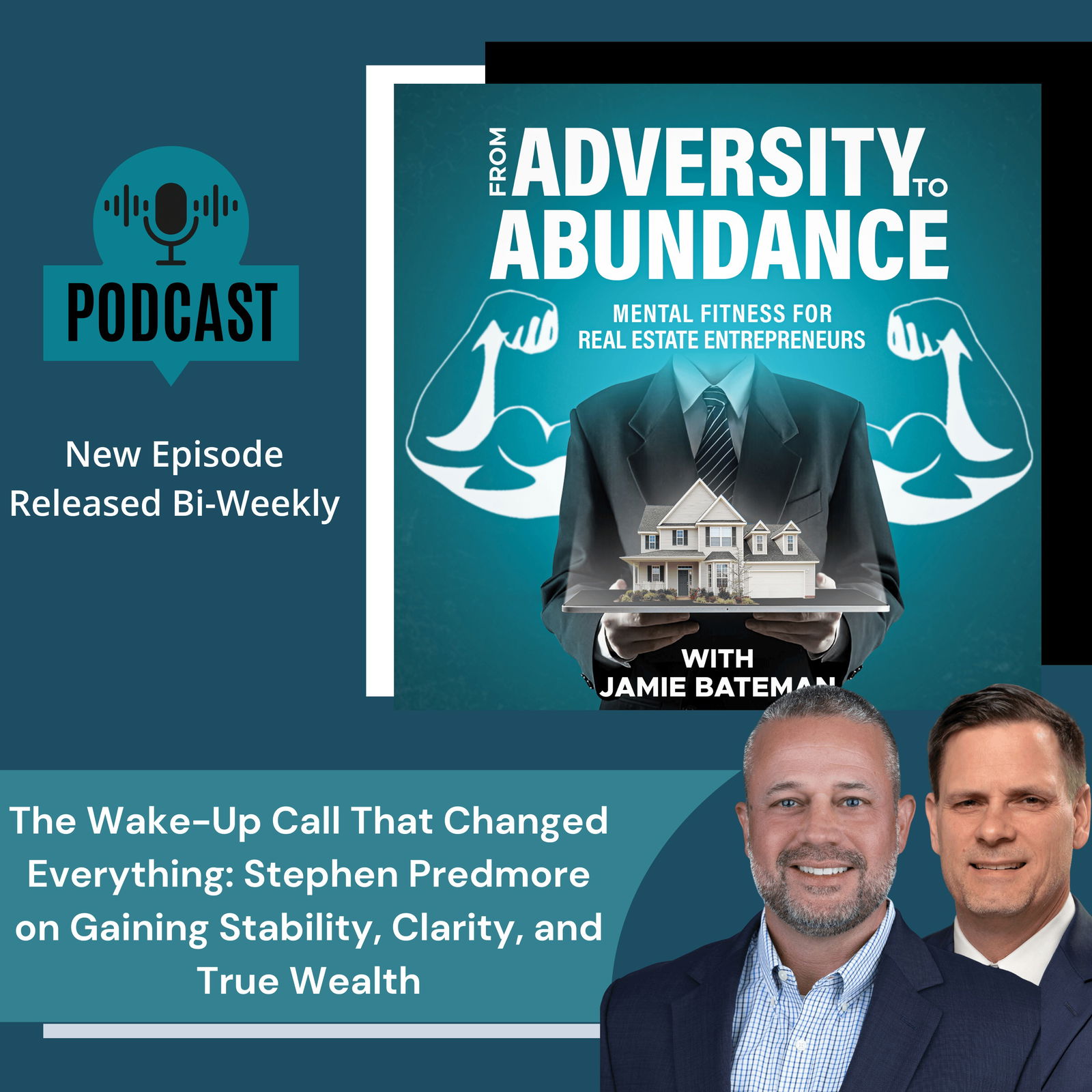
In this episode of From Adversity to Abundance, host Jamie Bateman sits down with Stephen Predmore, a long-time engineer who discovered firsthand how fragile job security can be—and how real estate investing can provide true financial stability.
After decades in a W-2 role, Stephen described himself as “fat, dumb, and happy,” comfortable in his career until an unexpected financial blow upended everything he thought was secure. In an instant, his primary income source dried up, forcing him to rethink his entire approach to wealth and security.
Instead of retreating, Stephen took action. He began building multiple streams of income through single-family and multifamily real estate investments—first as an active investor, and later by helping others invest passively. Today, he focuses on empowering fellow engineers and professionals to diversify their income and invest with confidence.
This episode is deeply relatable and practical, showing how adversity can serve as the wake-up call that pushes us toward abundance. Stephen’s journey highlights how anyone—no matter their background—can take control of their financial future with the right mindset and plan.
Guest Introduction: Stephen PredmoreStephen Predmore is a veteran engineer turned real estate investor who helps professionals, particularly engineers, transition from relying solely on W-2 income to building wealth through real estate. Having experienced sudden job loss himself, Stephen now invests in both single-family and multifamily assets and mentors others on creating passive income streams.
Episode Highlights- The Wake-Up Call – How Stephen’s sense of financial security vanished overnight and forced him to take control.
- From Active to Passive Investing – Why Stephen shifted from hands-on property management to multifamily syndications.
- Diversifying Income Streams – How he built stability by creating multiple sources of income.
- Helping Other Engineers Invest – Stephen’s mission to guide fellow professionals toward financial independence.
- Mindset Shift After Adversity – The lessons that transformed how he views money, risk, and opportunity.
Key Takeaways- Job security can be an illusion—diversification is essential for true financial freedom.
- Real estate investing offers practical ways to build stability outside your W-2 job.
- Adversity can be the turning point that fuels growth and clarity.
- Helping others invest can multiply your own sense of purpose and abundance.
Learn More about Stephen Predmore:
Website:
http://www.TalbottInvestments.com
Instagram:
http://instagram.com/stephenpredmore
Facebook:
http://facebook.com/stephen.predmore.7
LinkedIn:
http://linkedin.com/in/stephen-predmore
Learn More about Labrador Lending:
Integrity Income Fund:
https://labradorlending.com/investors/passive-investors/
Labrador Mentorship:
labradorlending.com/investors/active-investors/
—
Haven Financial Services:
Learn more: jamie.myfinancialhaven.com/
—
Purchase Jamie’s Book: www.amazon.com/dp/B0CGTWJY1D?ref_=pe_3052080_397514860
—
Leave us a REVIEW: podcasts.apple.com/us/podcast/from-adversity-to-abundance/id1618672867?mt=2&ls=1
www.adversity2abundance.com/reviews/new/
Connect with us
Website: www.adversity2abundance.com
Facebook: https://www.facebook.com/labradorlending/
Instagram: https://www.instagram.com/labradorlendingllc/
LinkedIn https://www.linkedin.com/company/labrador-lending/?viewAsMember=true
Youtube: https://www.youtube.com/channel/UChYrpCUlqFYLy4HngRrmU9Q
Connect with Jamie
LinkedIn: www.linkedin.com/in/jamie-bateman-5359a811/
Twitter: twitter.com/batemanjames
Speaker 0
Today's conversation is with Steven Predmore. Steven is an engineer. He's been an engineer for many decades. He's a w two employee who's also been proactive in becoming a real estate investor on the side. And you're gonna hear about how, in Steven's words, he was fat, dumb, and happy, and all of a sudden, he got punched in the face, not literally. I'm not gonna give it all away, but financially, his security, you know, what he thought was secure source of income was just dried up instantly. And he talks a lot about how that changed his mindset and forced him to take action. Today's episode is a very relatable one even if you haven't experienced exactly what Steven has. This is one that you can learn from for sure because, I think when we tend to put all of our eggs in one basket, that can be quite risky. And now Steven has multiple sources of income and is, helping other investors invest passively into specifically multifamily projects. He's been a single family investor as well as a multifamily investor, both active and passive, and he's shifting a little bit more toward the passive side. And he's helping engineers and other investors understand how that they can get into the game as well. It's a very practical episode, very relatable episode, and I think you're gonna get a lot out of this. Thanks for listening. Speaker 1
From adversity to abundance, hosted by entrepreneur and seasoned real estate investor, Jamie Bateman, is the ultimate guide for active and passive investors seeking clarity, mental fitness, and the confidence to make inspired decisions in the world of real estate. With a decade plus of investing experience across various niches and a background as a combat veteran, former army officer, and multimillion dollar mortgage note company owner, Jamie brings a wealth of knowledge and inspiring stories to each episode. Through weekly episodes featuring insightful interviews with industry leaders and solo explorations of mindset and strategy, listeners will uncover actionable advice and tips to overcome challenges and build lasting financial success. Whether you're a seasoned investor or just starting, from adversity to abundance is your road map to turning obstacles into opportunities and achieving financial freedom. Speaker 0
Welcome, everybody, to another episode of the From Adversity to Abundance podcast. I'm your host, Jamie Bateman. And today, we have with us Steven Predmore. Steven, how are you doing today? Speaker 2
Great, Jimmy. I'm excited to be here and tell you my story and maybe learn some nuggets about real estate investing and how I would do things differently. Speaker 0
I love it. For the listener, Steven and I are in the same local area. We've met briefly in person before at the at the local pickleball club, which which is an addiction that I have. Not sure about if you're quite as into it as I am, Steven. But I'm not. But, and then, I've played, pickleball with your son several times. So, hoping to get to know you even better in the next, forty five minutes or so. So, for the listener who may not be familiar with you, Steven, talk about what things look like in your life today and some of the abundance that you're currently living in. Speaker 2
Sure. So, yeah, I'm a full time mechanical engineer. Work for a major aeronautical company here in the Baltimore region. Started out in the single family space. I've grown significantly in the past couple years, from from two units to over two hundred units. It's like a hundred x, increase in in units over a very short period of time. And, still working my w two, but, yeah, that's that's kind of my abundance. Really enjoy scaling and and doing bigger deals now. Speaker 0
Absolutely. Yeah. And I I think we're gonna get into this, but I I think, you know, there must be some peace that you have. I'm sure you're very busy, but there there's probably an element of peace and security knowing that not all your eggs are in one basket and that you've got multiple streams of income. When you say two hundred units, is that I'm assuming some of that is, like, is a passive LP investor? Speaker 2
Some of it is passive. Some of it is active. Some of it is JV. Speaker 2
it is a co GP. Yeah. So kind of a mix of all all the above. Speaker 0
Okay. Perfect. Yeah. I can't wait to get into that in in a few minutes. Let's jump back, though, into your backstory. I think your story is gonna be, relatable for a lot of people, and whether, you know, this whether what's happened to you has happened to the listener or not, it's something that I think could happen easily to anyone. But let's jump back. Where do you wanna start? Speaker 2
So I'll I'll start, in college. Got a degree in mechanical engineering, and I, you know, got a job immediately out of college up in Buffalo. Wasn't excited about living in that area. So, you know, after a few years of working, it was actually at a General Motors facility. I decided to move down to Baltimore with with the family and, you know, was was fat, dumb, and happy working for a major auto manufacturer, highly technical. We worked at a very, high end, technical new stuff, batteries, electronics, a lot of very, very the skills were were not easy transferable. So Mhmm. I I was very comfortable, and I didn't feel like anything would ever happen to me. Speaker 0
Right. Right. So and about what what year did you move to Baltimore? Speaker 2
It'd be nineteen ninety seven. Speaker 0
Okay. Going back a couple Speaker 2
Almost thirty years ago. Yeah. Speaker 0
More than almost three. Yeah. So okay. So nineteen ninety seven, and you'd already, been out into the workforce before that. And so, essentially, you you were doing well in your career and and everything. Not that you didn't have challenges with family or work or anything, but for the most part, you were making decent money and had to, quote, unquote, secure job. Right? Speaker 0
Yeah. Yeah. And then what happened? Speaker 2
So I remember it was, the Monday after the Super Bowl twenty nineteen, and, we all walked into the office. And I worked in a I was an engineer. I was also in the IT area. Everybody got fired. The entire department was walked out. It was it was just an incredible feeling, and we never saw it coming. It was a punch to the gut. I was I was so indignant. I I I didn't I didn't feel like they even had the right, you know? It was just like, you know? And so but it was it was a top level decision. Like, it came down. My boss wasn't even aware that this was happening. So it was a top level decision that Right. They they closed the entire department. So, yeah, that was the big big seminal moment in my life, where, I I cut you know, twenty twenty plus years in this industry Right. And, just just let go just like that. Speaker 0
That's I mean, it's terrible, and it's just, incredible. Like so leading into that and, you know, say, twenty eighteen, I guess, basically, you can be as specific as you want, but how were things looking for you financially? You know? You know, you don't have to give, you know, your salary, but but just how was, like, your day to day life and family life specifically with in relation to, you know, your your your career? Speaker 2
Oh, I mean, we were we were fine. We had two two people two adults working, two young kids. Speaker 2
But we weren't saving aggressively. We, you know, you know, we were starting to put money into a five twenty nine, but we weren't aggressive savers, I would I would say. Mhmm. Also during that time, we used to love watching HGTV shows. And so I always had that real estate kind of bug back into my mind. Like, I could do that. I'm a handy guy. I could do that. And so that was kind of always bubbling. Right. When I got fired that day, I'd always been also listening to BiggerPockets. So Speaker 2
So I knew that if I had a four if I had a an old four zero one k Yeah. That I could that I could tap into that, and I can convert that to a self directed IRA. Speaker 2
So believe it or not, the day that I was fired, I remember sitting in the parking lot, and I had a, you know, twenty years with a with a company. I was thinking, now I could tap into that. Speaker 0
There's always an opportunity or or Speaker 2
upside. Right? Yeah. Of course, I was freaking out. You know? I got two kids. I got health insurance. You know? So there was a lot of emotions on that day. Speaker 0
Sure. I can only imagine. I mean and so and your plan up till that day was just to I don't wanna say ride it out, but just stay in that career and and do that for the rest of your profession. Speaker 2
Absolutely. I mean, yeah, I I I didn't have sometimes you need a moment like that to kinda smack you in the face to to kinda to say, what are you doing? You know? You're not you're not you're not saving aggressive enough. You're not you're not collecting hard assets. You're not, you know, you're not diversified enough. Speaker 0
Yeah. So you and you like, that day, you I mean, that was it. You didn't it's not like they gave you two weeks notice or anything like that. Right? Speaker 2
That day, no. So IT department, they typically just don't let you walk walk you walk, and they don't, you know, they immediately disable your account. Speaker 2
So you can't download files and and put you know? So, yeah, it was it was very sudden. You know? I grabbed my box. Actually, they didn't even allow me to collect my box. Wow. They they had somebody else pack up my desk, which is a little bit insulting as well. Speaker 0
Yeah. I've got a, I know you said you've listened to a few episodes. I've told this a few times, but I'm not won't tell it now. But, I ended up resigning, and I was with the government. So there was a little bit more security there, at least there used to be. And, but when you said the box, it it it triggered a a little memory there. You know? I've had my stuff packed up on a into a box and moved into, you know, by somebody else and just kinda put off in the corner there. And you it's just Yeah. I wasn't let go. I'm not saying I it's the same thing, but definitely I definitely felt like a number and just Oh, yeah. Did not feel, you know, like they cared at all, about me as a human. But so okay. I imagine this takes days and weeks to even just kind of process what's going through your mind. What are you what were your next steps at that time? Speaker 2
So one of the nice parting gifts they they give you was was, like, resume consulting services and and whatnot. So so, you know, we we worked on that, had somebody to help me with this, brushed up my LinkedIn profile, a lot of types of things to, you know, immediately start getting out there and applying. Speaker 2
that's that's what I was working on. Speaker 2
Of course, you're working on I mean, I did have a severance as well, so there was a few months of of severance. Speaker 0
Some cushion there. Speaker 2
Yeah. Cushion there. Speaker 2
yeah. But but in the back of my mind, I'm also thinking about the the whole, you know, now I have money because that's always the hardest part, your first deal. Speaker 0
Like Right. Right. Speaker 2
I'm not sure sure. Like Mhmm. You know, even in Baltimore, which is a very low cost of entry and market, high cash flow, you still need ten dollars twenty thousand just to kind of get the ball rolling. Well, I didn't really have that, but now I did. So that was kind of like the impetus to kind of get going. And I ended up buying my first house for sixty five thousand dollars Speaker 2
Single three, two in Baltimore, Speaker 0
Baltimore City, kind Speaker 2
of a Baltimore City, kind of a C class area, right? And put about forty thousand dollars of rehab into it. And I was renting for fourteen hundred dollars So from a cash flow perspective, I was crushing the one percent rules, like one point three, Right. And it looked great on paper. Everything looked great on paper. Right. Speaker 2
But, but did not didn't end up that way. I don't know if you're gonna get into that now. Speaker 0
Yeah. So, I mean, so we're not gonna focus on the rest of your your w two career. You know, but, you do currently have a w two. It sounds like you got a job relatively quickly after getting let go. Right? Speaker 2
I did. You know, I'm a licensed engineer. I have you know, it wasn't that difficult. It was more just kinda deciding where I wanted to work. Mhmm. Traffic and Speaker 0
Gotcha. Yeah. You're highly skilled and in a in a great, industry, you know, to to be able to land on your feet there. But a lot of people honestly would have just done that and not changed it, changed course, or started adding real estate to their portfolio. So you said you had been listening to BiggerPockets. Now you had a lump sum of cash or at least payments coming in. I'm not sure how that was structured, but little cushion there. And before you bought your first deal, though, what was you know, besides just kind of having watching HGTV and listening to BiggerPockets, that's different from buying a deal. So, like, the decision point, really, how did you decide I'm gonna buy, you know, rehab slash rental property? Speaker 2
Again, I'm a I'm a mechanical engineer. I'm a very handy guy. I just knew I could do it. Yeah. I started attending some meetups as well. So Okay. That that's certainly something that I recommend for anybody just starting out. It's just attending some meetups and and talking to people that are doing it. Absolutely. That that's the push that I needed. Yeah. I met I met a a banker there who kind of coached me on that and the self directed IRA and and different things that Speaker 2
Just just pushed me over. Speaker 0
Right. Right. Yeah. So that's Speaker 0
And for those who are not familiar, Baltimore can be it's I know a lot of cities tend to be like this, but it's just very block by block block by block, and it's, you know, sounds like I don't know where you bought that, but I think you alluded to this. A lot of properties can look really good on paper. And in reality, it's could be a ton of work, maybe a lot of vacancy, and a lot of Yeah. Additional rehab even after, you know, or Yep. CapEx that's needed even after the rehab that you did. So how did that first deal turn out in the longer term? Speaker 2
So it went well for about six months, and then COVID hit, and my tenant stopped paying. Mhmm. And I was unable to get them out. Maryland's a very blue state, very tenant friendly. And, you know, it was my first time doing it. So here's another lesson learned. I wanted to do everything myself. I was I was indignant that this person wasn't paying, so I was gonna take them to court, and I was gonna see through this that they did pay me. Right. A total waste of time. Complete waste of time. I don't know how many days I had to take off to to go down to the Baltimore City courthouse and and and get delayed another month because they're they're sick or something like that. They didn't show up. So anyway, it didn't turn out well. So when I did finally get them out and I again, six months, I lost six months of rent. Speaker 0
Right. Which is a lot. Speaker 2
Which is a lot, and I'm still paying the mortgage. Right. I'd I went I kinda pivoted to the section eight route because I'd heard, you know, there was a guaranteed way to do it. So that same house, I just made it a section eight Speaker 2
And that worked out better for a bit. You get the guaranteed rent on the first of the month, at least a portion of it. Speaker 2
Yeah. That was going well for about the first eight months. And then even that small portion that the tenant had to pay, she started falling behind on. Speaker 2
So it was just it was just a hassle. It was just, it's just Right. You know, dealing with tenants and there and there's some of their, you know, sob stories and Right. Yeah. So I ended up selling that after one year of section eight rental. Speaker 0
Gotcha. So a little over, like, maybe eight. How long did you own it for in total? Speaker 2
Like, two years. Speaker 2
Two years. Yeah. Speaker 0
Well, I mean, honestly, a lot of people may have just quit real estate at that point. You know? So kudos to you because I know you obviously didn't. Right. Yeah. It can be it can be challenging for sure. I mean, yeah, my first was, I guess, was my second rental really because our first one was we just got lucky. It was like a it was a condo, and I put an ad in Craig's on Craigslist. And Speaker 0
A single father, you know, applied, and he's paid he's been there for sixteen years. Never missed a I mean, he pays early every month. It's just like so that's the kind of the the numbers weren't amazing, but it's just like it was really pretty far on the passive side of the spectrum. And then the second one, which was more after I'd really decided to do this more you know, take it more seriously as far as real estate investing, was, an attorney. An attorney was our tenant, and she started to move in and then changed her mind, and she wanted to break the lease. And, you know, I I guess when you said you were indignant, that's kind of how I was. I was like, wait a minute. You can't break the lease. What are you talking about? And so she's she created I can't I guess, legally, I'm not actually supposed to go into too much detail, but she lawyered up and created some stories about why Sure. You know, she couldn't be there. And, Yeah. But I I guess stepping back or or fast forwarding and and zooming out, you start to realize, like, you know, don't let your emotions get into it too much because at the end of the day, that would have been a terrible tenant to have, you know, long term. So the the lawyers I did consult with said, hey. Just be thankful that she's not your tenant because she's showing you she wouldn't be a fun tenant to have. So we missed and I was concerned about vacancy for long you know, many, many months. We ended up missing out on two or three months of vacancy in it I mean, of of rent due to the vacancy. But, yeah, it it's just, like, sometimes it's just not worth fighting those battles. Yep. And I know we're gonna you you transitioned eventually from single family into multifamily. I'm curious for the listener who may be a newer real estate investor. What would you say about self managing your properties? Let's say single family properties. We did that. I did that for several years initially, and, now it's like I I love having a property manager. But curious what your thoughts are there. Speaker 2
My thoughts are you should do it for a year. Speaker 2
I think there's there's there's tons of value in in learning the process and Speaker 2
In in that. And and you've then you really do value your property manager who handles that for you. Speaker 2
But, I I think it's good. I I I did some of the some of the repairs as well. And, again, I wouldn't do that again in the future. I wouldn't go to court by myself. You know, a lot of these things I've just kinda learned, like, you gotta go through it once, and after you do, you realize there's professionals that do it much better for you cheaper than ultimately cheaper. Yeah. Speaker 0
Yeah. And you're right. You can I I can now I I trust my property manager, but I I know if they're doing a good job or not ripping me off because I I did it for a while? Right. Yep. Or if they should be doing better at filling, you know, reducing vacancies, etcetera. So did you stay in the single family game for for a while after that? Speaker 2
No. So I I ultimately had, two two single families. And when I sold the first one, I I ended up rolling that into my first, multifamily syndication. Speaker 2
I had, I had joined a a couple mastermind groups after my single family days and, just started to see the bigger picture. Started networking with with people that, had done this before and I just saw the numbers. It was just a it just made sense as an engineer. I could see, you know, one vacancy on my single family is you know, or hot water heater going out is is killing my cash flow for the year. Right. So I I I I I pivoted and started putting money in into various types of multifamily deals. Again, we start I started with a syndication. I invested in a, like, a fund that was Yeah. Set up over multiple assets. Yeah. Then we Speaker 0
Those were multifamily assets? Speaker 2
Multifamily and and a one hotel. Speaker 0
Okay. Gotcha. Mhmm. Yeah. We have a mortgage note fund. I mean, they're all generally the same as far as first lien mortgage notes. But, you know, for oftentimes, you know, in multifamily, as you know, it's it's one project that you're investing in Yeah. With many different people. So so how did you come up with the capital to make all of those investments? Speaker 2
So I started saving aggressively. Okay. I kinda had a I I also have a side hustle that, is is adjacent to the space. I I run a handyman business on the side. Okay. And I started funneling all that money all into real estate, all into back into the business. Yeah. I started hiring VAs and helping with that. I brushed up my website. I started paying for more, you know, a bigger nicer CRM, more automation. So kinda just honestly, to this date, everything that I've earned is just going back into the business. Right. Speaker 0
But I say but by the way, you said business, and it's like I think the key is you weren't treating it like a single family rental or just I mean, you're starting to treat your real estate investing like a business even if we're talking about putting capital in passively as an LP. You were treating this as a business. It sounds like with systems and hiring VAs, and I'm a big fan of of working with VAs as well. Okay. So just talk to us about the growth over the next few years. Speaker 2
Sure. So so, you know, I did that first syndication. Then, you know, within these masterminds, there's a lot of people like me that are kind of just wanting to do their own deals. And so we kind of teamed up a few of us, and we we we've purchased, a couple of properties. So we've done a couple as a JV deal. We bought a third unit in Anchorage, Alaska. We have a twenty three unit in West Virginia. We've done a syndication, a fifty four unit in North Carolina. So kind of doing that in addition to also investing in other operators deals as an LP. Speaker 2
So I'm kind of doing a lot of different things right now, and I'm certainly I I I did. Like like I said, we did the deal in Alaska. We've exited that. I would never do that again. Mhmm. I'm kinda now, like, narrowing my focus onto where I wanna invest, how I wanna invest, and the people that I wanna invest with. Speaker 0
So Right. Yeah. It's important for sure. Okay. And so and at this point, what does your portfolio look like? You touched on it earlier, but in a little maybe in a little more detail. Speaker 2
So I'm gonna say over two hundred units. Some some is JV, some is a CoGP, some is an LP. Gotcha. You have some self storage units, but really focusing on large multifamily now value add Mhmm. Red states Speaker 2
With top with top tier operators now. Speaker 0
I think that's that's the key. Right? Speaker 2
Yeah. It's the operations. I I've I've gotten burned on on some where I didn't do the proper due diligence. I trusted, you know, the capital raiser that I was working with. And Speaker 2
But yeah. So now it's it's a lot more, doing due diligence on the operator, visiting them, looking at their properties, looking at their underwriting, that that type of stuff. Speaker 0
Yeah. So you and your partners generally bring the capital, right, to to place in those those situations. Right? Speaker 2
Yeah. So so with my my my company, Talbot Investments, we Yeah. Kind of we raise capital for large syndication deals. Right. We we analyze the deal. We actually have a fund structure now. So we're we're bringing we're able to write a larger check as an LP Nice. And we get better we get better returns for for for writing that larger check. Speaker 0
Okay. So it's like a fund to fund model kind of thing. Alright. Correct. Yeah. I think it's interesting how, you know, it it one of the things I realized years ago with, you know, kind of trying to market to clients was, alright, most people fit in either the active or passive bucket, generally speaking. Right? Either you have money and, you you know, and but you don't have the time or the energy or the desire to learn how to be an expert real estate operator, or you you don't have money and maybe you're younger, but you have energy, maybe you have time, and you you wanna learn this and you wanna run a business. Usually, people tend to gravitate to one or the other. But Right. More and more, I've realized there is this kind of overlap. If you did a Venn diagram, there's this kind of person in the middle, and I think I'm one of them because I'm I'm a passive investor as well. You know, and and we've actually started in our business starting to try we're starting to try to serve some of those people where, they may have capital, but they want maybe more of the control Mhmm. Versus putting their money into a fund because, let's face it, you essentially lose almost all control once you put your money into a fund. And that's not I mean, I run a fund. I invest in funds. I'm I'm not anti fund, but there's that middle ground where it's like, okay. They're sort of an active passive investors. It seems like you fit into that category. Speaker 2
I do. Yeah. And that's more the JV deals kinda come in. Speaker 2
I have a couple of them right now. You know, if the opportunity comes up, I would invest in a JV deal. I want it to be a little bit closer to me. Some of the surrounding red states that that I that could invest in. But at least from my business perspective, like, I'm typically just raising money for other operators deals. That's kind of where I am. And this is all it's changed. Right? I never thought I would be, like, a full time capital raiser. That was just so foreign to me. But Right. You know, as as my job has changed, actually, my job, my w two is starting to get a bit more hectic. Speaker 2
And I'm not able to do some of those JV things that I need to do. Sure. So I'm kind of transitioning more into just kind of telling other engineers, like, my story and, you know, kind of showing them, hey, you can you don't have to be a millionaire to to invest in these deals. You know? Speaker 2
You can you can take money from an old four zero one k, and you can Right. Roll that into a deal. And, honestly, I make better money when I invest with these with these bigger operators, which is just interesting. But yeah. Speaker 0
Well, you alluded to it earlier about trusting experts who to do their job. Right? Obviously, you need to vet them for sure. But we we see a lot of engineers. I've see I see a lot of engineers, come over into the real estate space writ large, I guess, you would say. A lot of them this is a broad generalization, and the the even the term engineer is pretty broad. Right? But, you know, a lot of the engineers I've worked with are obviously very analytical and very smart, but sometimes don't wanna take action. And they've they've run the analysis on I've I've mentored people who've run analysis detailed analysis on hundreds of mortgage notes, not using AI, you know, manually, and never even bid on a note. You know? It's like and they have money. And so how do you get over that hump? You know, for the engineer or anyone else who suffers from analysis paralysis, how were you able to take action? Does it go back to you getting let go, or or what's what's what why do you Speaker 2
take Getting let go, going to meetups, meeting people? I mean, I was an action taker. Speaker 2
You know? Yes. I had spreadsheets, but I was I was going out and meeting people and shaking hands. That's that's I think that's kind of what got me over the edge because, yeah, you can sit behind a PC and look at those spreadsheets all day. You can find you can always talk yourself out of a deal. Speaker 0
Oh, for sure. There's always a reason not to invest. And the truth is, though, the numbers are when when as soon as you buy the deal or invest, the spreadsheet is gonna be wrong. So you're it's never gonna be correct. Yeah. But you know? Speaker 2
So So it's it's just getting just getting out of that, and and getting out and and being comfortable. I mean, that's scary. Those first meetups, I remember, it was very scary walking into a meeting. I have no idea what I'm doing. I don't have any real estate experience. Speaker 2
So I think you just gotta get over that. Maybe have a find a friend that that'll go to your first meetup with you. That's, you know, that that that's helpful. Speaker 0
Have I seen I think I've seen online you've been going to the the mid Maryland meetup. Is that it that's a fairly new one with Marco Barrio. Is that right? Okay. Yep. Yeah. He's a a note guy, as well. I need to get out there. We've I've talked to him about that and, have to have to go there soon. But, that's monthly. Right? Speaker 2
It is monthly. Yep. Speaker 2
Yep. But it but it's, you know, it's mid Maryland. I'm not really investing in Maryland anymore. Right. So Speaker 0
Yeah. Right. Right. Is it is it right. Does it is it is it the right fit? But what would you say the person who, you know, what's says, I I have a w two and a family. I don't have time to invest in real estate. How how are how are you approaching that? Speaker 2
I say you should look at really look at passive investing. It's, it's not it's not a REIT. You're not investing in a real estate stock. You're you're investing in hard assets where you get a k one, you get the depreciation. Speaker 2
And that's a great way to get started. If ultimately, like, you do want to be more active, I would still say invest passively in a deal. Sure. See what their communication is. See see how they operate. Right. There's a lot of value in just seeing how other operators operate. Speaker 0
Sure. Absolutely. You mentioned a couple times a self directed IRA. Some of our listeners are familiar with that, some aren't. And that term is used broadly to their other types of self directed accounts. But I think what people may not realize oftentimes is that, you know, the they they think, well, I don't have a self directed IRA, so I can't do that. Or or I'd have to close out my four zero one k entirely and take all the money out of it. That's just not true. So talk to us about just briefly the process or what someone might be able to do if they if they're sitting say they I don't know. Maybe they have three hundred k or five hundred k in their four zero one or in their four zero one k. Mhmm. What could they do? They could take some of that money and create a self directed IRA. Right? Speaker 2
No. So not not directly from your four zero one k. No. If if your four zero one k is your active job, you can take a fifth you can take a fifty percent loan against that. Mhmm. Again, your active job. I've also done that as well. So you can you can take that, and it doesn't that's not a self directed you can just take a loan against that and use whatever you want. You're repaying you know, the money is not in the stock market when you're doing that. Speaker 2
is for eight one k. Speaker 2
So that's one avenue. The other avenue is a former job. Right. So when you leave a job, your four zero one k sits there Yeah. And you'd now have the ability to roll that into a self directed IRA. Right. And and most people don't. What they do is when they start their next job, the new administrator says, hey. Do you wanna just take your money and put it into into your new four zero one k? Most people don't even think about it and just say yes, and then all of a sudden then you really can't access that. So it's it's when you leave that job Yeah. You have access to it. Roll to self directed. Right? Yeah. And you can invest that into alternative investments. You can do invest it into oil and gas, crypto, art, real estate. There's lots of things you can do with that. Speaker 0
Yeah. It's interesting how the four zero one k has become the, like, the only essentially, like, the go to investment vehicle or or savings vehicle retirement vehicle, I guess, I should say. And when I've heard the guy who created the code wrote the code for the four zero one k, I've heard him on podcast saying I never intended this to be the this end all be all for everyone. Right. But and, also, what you can do is take if you do leave your job and switch employers, you can if you're not ready to create a self directed IRA, you have the option of of moving that money over to a, like, a traditional IRA that still invests in the stock market Speaker 0
You know, whatever the s and p until you research different real estate options. And then then you can move that money into a self directed IRA. Right? Yep. Okay. Yep. But there there are options there, and and people often just don't realize they they even have the capital that they could invest. So I think that's one of the things we're trying to educate people on. Not saying it's definitely right for everyone, but it's an option. And, ultimately, this is your it's your money, and you need to take control of it. So, you know, how did you learn about self directed IRAs? It was from the meetups, you said? Speaker 2
Meetups, Bigger Pockets. Yeah. Honestly, that's kinda what got me going. And then just calling some and and Right. You're hearing it out. I actually went with the, checkbook control self directed IRA, which which was a little bit more to set up, but, Right. Just to kind of eliminates the intermediary as far as making the decisions and cutting Speaker 0
More control, lower fees, more flexibility, I guess. I've never done that. Speaker 2
There's more fees initially because you have to create an Speaker 2
gotta create an an LLC, and you're the manager of the LLC. So yeah. Speaker 0
So talk to us about the multifamily space in general. Like, you know, it's been pretty rocky, I guess. You know, I'm not a multifamily guy, but I do I have invested in multifamily projects and follow it from a distance. How are interest rates affecting NOI and if you know, we we don't have a crystal ball, but what are things looking like right now, and how do you foresee things going in the future? Speaker 2
Everything's on sale right now, Jamie. It's a lot of distress. There's a lot of distress in the market. Speaker 2
A lot of a lot of, you know, multifamily commercial type stuff is is is typically on a five year Speaker 2
And so a lot of deals are now in trouble because interest rates have tripled since they took down the deal. Right. And operators need to either come to the table with money to refi or just to show the liquidity or the DSCR that the bank wants. Speaker 2
So again, there's a lot of stuff on sale. There's a lot of people in distress. There's there's there's, we we we've just found a couple of deals where either it's bank owned or there's some type of disagreement between the ownership. There's been private equity bought in brought in to save the deal, and now they wanna sell it. And Mhmm. So the again, that's that's what we're seeing Yeah. A lot of deals Speaker 0
right now. Yep. Okay. Yeah. Because I know that if they're on floating rate debt, not only do their the the debt coverage, you know, it goes up. They they expend the the expense of the debt, it goes up short term, but also that brings down the value of the property. Right? Yep. Speaker 0
Yeah. So that that's put a lot of operators and owners in into a tough spot right now, so that's why things are on sale. Yep. So at least a couple big big factors there. So and do you foresee that being true for for a while? Speaker 2
I'd say the next eighteen months or so. You know, I think interest rates are going to stop start going down a little bit. Yeah. So Speaker 0
Yeah. You know, and and it's Speaker 2
I don't know. That this is why I liked being with bigger operators that have large teams that that kind of study the Speaker 0
They do the research. Speaker 2
The the macros Yeah. About it. I just know where I wanna invest. I wanna be, like, in blue states. I like the Carolinas, Texas. Speaker 0
Yeah. You don't like the blue states. You like the red states. Right? Speaker 2
Yeah. Yeah. That's that's correct. Yeah. And it just because I got burned on it, so I just know that you know and these are booming areas, lot of growth. Speaker 2
know, the like, the research triangle and Charlotte areas are just booming with with new Speaker 2
Population growth and and and rent growth. So, yeah, that's that's where I like to invest, where people are going. Speaker 0
Alright. And so for you personally, you already said you're you're kind of your w two is getting a little crazy, and, you you're maybe shifting slightly more toward the the passive side of things and helping other other engineers understand how they can do this. Right? Speaker 0
Awesome. Hopefully, your employer isn't listening, but do you feel, like, do do you plan to stay at your job for a long time? Or Speaker 2
I I do. I think I I give myself credibility. I give myself some street cred by by by keeping the job and saying, hey. You know, I was an engineer. I am an engineer, and I'm still doing this on the side. Yeah. Speaker 2
There there's there's value in in being able to to say that you can do both. And Right. You know, I I would do passive again. I wouldn't I wouldn't you know, I talk to a lot of people that, yeah, I wanna flip a house. I wanna I wanna do a rental. And I'm just like Right. You know, that may look great on a spreadsheet, but you just are not taking into account your time and and and what can go wrong just doesn't show up on a spreadsheet. And, Speaker 0
Right. Well, I think to us, people, you know, there are there are, I mean, there are Ponzi schemes out there, and there are fraudsters out there. And so I think the key one of the big things for me that you said earlier is just doing due diligence on the operator. I think that's one thing that scares people off because, about being an LP or being a passive investor is, well, I I don't I don't want my money to just vanish, and so how do I trust this person, the operator? So can you give maybe one or two things that you do to evaluate an operator? Speaker 2
So I look at I look at history. I look at number of full cycle deals. So I want somebody that's been there around the you know, not just for the heydays of the early teens there where everybody was making money. I want people that have gone full cycle on deals. I want people that understand the debt cycle and understand if they do get a variable rate loan, like, what is their plan? Are they buying rate caps? What is their exit strategies? Because honestly, you can get variable rate debt on some of these properties, and it gives you more flexibility. It allows you to exit earlier if you've already hit your operational things. Otherwise, if you're locked into, like, a five year note, fixed rate, it looks great, but there's huge prepayment penalties if you wanna get out. So just people that understand that type of thing. I like the markets that they invest in. That's a huge thing for me. They have large groups that look for tax tax abatements. You know, one of the largest line items on an NOI sheet is your taxes. So looking for opportunities where you can get abatements and eliminate a large portion of those taxes. Also, insurance. Insurance is the second largest line item. If you can have a large operator, you can get a large blanket. So there's lots of, you know, economies of scale. Those are the things I look for. Speaker 0
Right. Right. Gotcha. And what age were you when you you bought you bought your first, the rental in Baltimore? Speaker 0
Late forties. Late forties. So Speaker 0
I mean, what do you say to the person who's like, you know what? I'm I'm forty five. I missed the boat. I can't I can't be an investor. Speaker 2
I say take a look at your if if you don't have the the the money right now, get educated. Find somebody you like. Get educated in the space that you wanna invest in. Mhmm. Look at ways that you can tap into some retirement funds. Some of these deals are crushing what I'm making in the stock market. Obviously, you want to be diversified. I still have a four zero one ks. I still do all that. I'm diversified, but I take a portion of that and I put it into hard assets Speaker 2
That that have a have a better return. And let's tip our typical deals are we have modeled for five years, and we typically say you double your money in five years. So if you put in fifty ks thing, we'll double it in five years. That's a twenty percent ARR, sixteen IRR. So it's a better return that you're going to get than just you know Right. Per over the stock market. Speaker 0
Right. Plus you're getting tax benefits and and other things. Speaker 2
Tax benefits is a huge things that people don't even think about. It's one of the only I don't know where else you can get these types of tax benefits to to shield some of your income. And once you've kind of been in like, done these deals every every five years, the money starts turning over. You've doubled your money. Now you can invest that again, and it starts starts this hamster wheel of just and that that's where I'm at. I'm I'm almost at the point where some of my earlier deals have kind of come full cycle, and it's gonna start feeding itself. So I'm I'm very excited about that. Speaker 0
Yeah. And then you can get Peyton a new pickleball paddle. Speaker 2
He's got only four. Just kidding. Speaker 0
Alright. So this is this has been great. I mean, it's I love, that, you know, there's not I I say this on the show often, but there's just not one way to get to, quote, unquote, success. You know? It's not like there's so many different ways to make money in real estate and outside of real estate. There's just so many paths that people people take, whether you're working at w two. I worked at w two for a a while, and then I went part time and still worked at w two for seven years while I was building my real estate portfolio. Speaker 0
You know? So and then eventually left my w two. But, you know, I was able to keep health benefits and things through that whole period, but, you know, there there's not one way to do it. You know? And I I like that personally. It's like there's there's many paths to Speaker 0
To, be financially free. Awesome. What, got got some rapid fire questions for you. You ready? Ready. Alright. If you could have coffee with any historical figure, whom would you choose? Speaker 2
I'm gonna say George Washington. Okay. Speaker 2
Yeah. I've read the I've read the Hamilton book. I I saw the play. I read the Hamilton book. Yeah. Just a fantastic book. And just the dynamic between Hamilton and Washington, it was Washington was such a reluctant leader, and he he loved how he had Hamilton by his side because he was so eloquent with the pen and with, you know, speech. And, just I love that dynamic and and hearing how they Speaker 0
yeah. If you could go back and give your eighteen year old self some advice, what would that be? Speaker 2
I would say, house hack. I would do a house hack Speaker 2
Immediately. That's such a great way to Speaker 2
Great way to get started. You're you're you gotta live somewhere anyway. You might as well do it for live for free by renting you know, getting a quad and renting out the three rooms to your buddies and Right. You're living for free. Speaker 0
I I couldn't agree more. If you were given ten million dollars tomorrow, what would you do with it? Speaker 2
I'd invest passively in some some real estate. Speaker 0
Awesome. What's a challenge that you Speaker 2
top tier operator. Not not just anybody. Speaker 0
What what's one challenge that you're facing in your investing career right now? Speaker 2
So it's certainly raising capital at a at a at a higher level than I'm currently doing. That's that's and it's it's a you know, I'm new to the game. I'm just kind of been in this space, I would say, six, nine months. Right. So it's learning how to, you know, turn these conversations into people that actually will write a check for you, that that believe in you enough. So that's that's certainly a challenge is raising capital. Speaker 0
Yeah. No. I think it's I I can I can relate to that one? In your opinion, what's what's one of the most important personality traits for someone to be successful in real estate investing? Speaker 2
Gotta have grit. Gotta be willing to get kicked in the mouth and and get up again. I've I've been there. You know, I was ten thousand dollars, in late rate rent payments from my first deal. And, you know, like you said, I could have walked away and said this is Right. This is not worth it. Yeah. But, I just I knew that I knew real estate, you know, was a was a great way to pass to to to and on the future. Like Right. It's not just For sure. Right now. And so I I took that ten thousand dollar loss and said, you know what? That's a that's a ten thousand dollar learning lesson. Speaker 0
Well, a couple of things I pull from that is long the long term view, which you just alluded you just mentioned. You you weren't just so focused on the short term. You you were still looking at the long term. So you knew you could have a couple hiccups and challenges and still be okay. But, secondly, you you you didn't quit, but but with that, you did change course. Speaker 0
So you pivoted. So Yep. You know, it's not like you said, no. I'm gonna buy another house in the on the same street and do the same thing again. You know? So I I I think for me, sometimes I can get a little bit you know, have almost too much grit where I'm, like, too stubborn and don't shift course. I think I've gotten better at it adjusting to the industry conditions and and whatever else. But yeah. So you didn't quit, but you did you did change your your plan a little bit. So I think, any anything you wanna add there? Speaker 2
Well, yeah, I also invested in myself at that point. You know? It's like Oh, right. Investing in a mastermind is not a cheap endeavor, and, you know, it's not immediate returns. So, you know, some people would say, well, why are you spending, you know, whatever, thousands of dollars to to be in this group of people that all kinda look like and and sound like you. And it's just like it's it's contagious. You need to be around people like that. Speaker 0
Yeah. What's a book or two that you could recommend for our listeners, Steven? Speaker 2
You know, I'm gonna go with who not how. Nice. I've read it a couple times. Each time I've read it, I've hired an additional VA. Speaker 2
It's it's really it's it's really kinda just made me focus on on the correct things. Speaker 0
Yeah. It's an easy read, and most of his books are, but but it's really valuable. I mean, it's it's got a lot of wisdom in it. Speaker 2
Just taking taking things off my plate that that really I should not be doing. Social media, just scheduling calls Right. That type of stuff. Speaker 0
Court appearances. Just kidding. Speaker 2
Court appearances should be Speaker 0
how has financial abundance made your life better? Speaker 2
Just more more appreciative of trying to it's it's great to be able to to to kinda show this to to my kids as well. It's given me just a different outlook and more confidence in what I'm doing. Speaker 2
That that's that's it. And having clarity in what I wanna do. You know? I know where I'm gonna be Speaker 0
Where you're going? Speaker 2
Where you're headed? I I I may still be working again. I like that I like that street cred thing. Speaker 2
I don't know. Yeah. I don't know. If I if I were to walk away from my job, I I think I would be very bored. Speaker 0
Yeah. For sure. They talk about retiring to something, not Speaker 0
Yeah. From something. Yeah. But I imagine it also gives you does it give you a little little the the real estate income and and profits, maybe upon the exit, gives you a little more security with, if something does happen again with your w two. Right? Speaker 2
Sure. Sure. Absolutely. Speaker 0
Yep. What's one question that you wish I'd asked that I haven't? Speaker 2
You know, what is your why? Why are you doing this? Speaker 0
What's your why, Steven? Speaker 2
So it's it's my kids and my family. It's it's it's showing them, you know, a better way that that I did it. You know, you you need to invest in in not just the don't be so tapped into the stock market and the four zero one k. There's other assets that you can be growing. Speaker 2
The equity that you can get from a house hack is just incredible. You can get it so cheaply. So, yeah, it's just kind of showing them Sure. How I think that they could live a very fruitful and abundant life. Speaker 0
I love it. You mentioned your company earlier. Can you say the name again, and and where can our listeners find you online?
Speaker 2
Sure. Talbot Investments. And at talbot investments dot com slash engineers, a free download that I I created for engineers to show them some, like, twelve reasons why I believe that you should look at passive investing over active investing based on lessons that I've learned. You know, don't be fooled by HGTV, how easy it looks. There's lots of things that you're not looking, thinking about, LLC costs and and just lots of costs that are just not on the radar.
Speaker 2
So that's the best way. Talbot investments dot com.
Speaker 0
Love it. Yeah. I think a lot of people are sold the the passive investing thing and and but they think that means buying rental properties and owning them. And there are ways to be a passive investor for sure. I mean, I have we have a mortgage note fund for accredited investors, and you've got opportunities all the time as well. But I think studying that operator is critical. Hopefully, the the operators don't read your books, and we might not have any good operators. Just kidding. Awesome. Steven, this is a lot of fun. Thanks a lot for joining us. I I, you know, hate that you got laid off out of nowhere, obviously, and, you know, it's it's one of those, you know, I imagine maybe you're looking back at at it and and would you call it a blessing in disguise in hindsight?
Speaker 2
Hundred percent. Kick it you know, punch in the mouth that I needed Yeah. And to slap you out of the the four zero one k, and you're good. And you stick with the company for twenty years and get the gold watch, and you're you're all set. No. It was it was a punch in the mouth that I needed.
Speaker 0
Right. Absolutely. Awesome, Steven. Well, thank you so much. Really appreciate the time.
Speaker 2
Great. Thank you, Jamie. You had a great time, and best luck to everyone.
Speaker 0
And, to listener, thank you for spending your most valuable resource with us, and that is your time. Thanks, everyone. Take care.
Speaker 1
Thank you for joining us on From Adversity to Abundance. We hope today's episode has equipped you with valuable insights and practical advice to elevate your real estate journey. For more inspiring stories and resources, visit us at w w w dot adversity to abundance dot com. If this episode has inspired you, please share it with a friend who could also benefit from our conversation. Together, let's turn adversity into abundance. Until next time, keep building your mental fitness and your real estate empire.