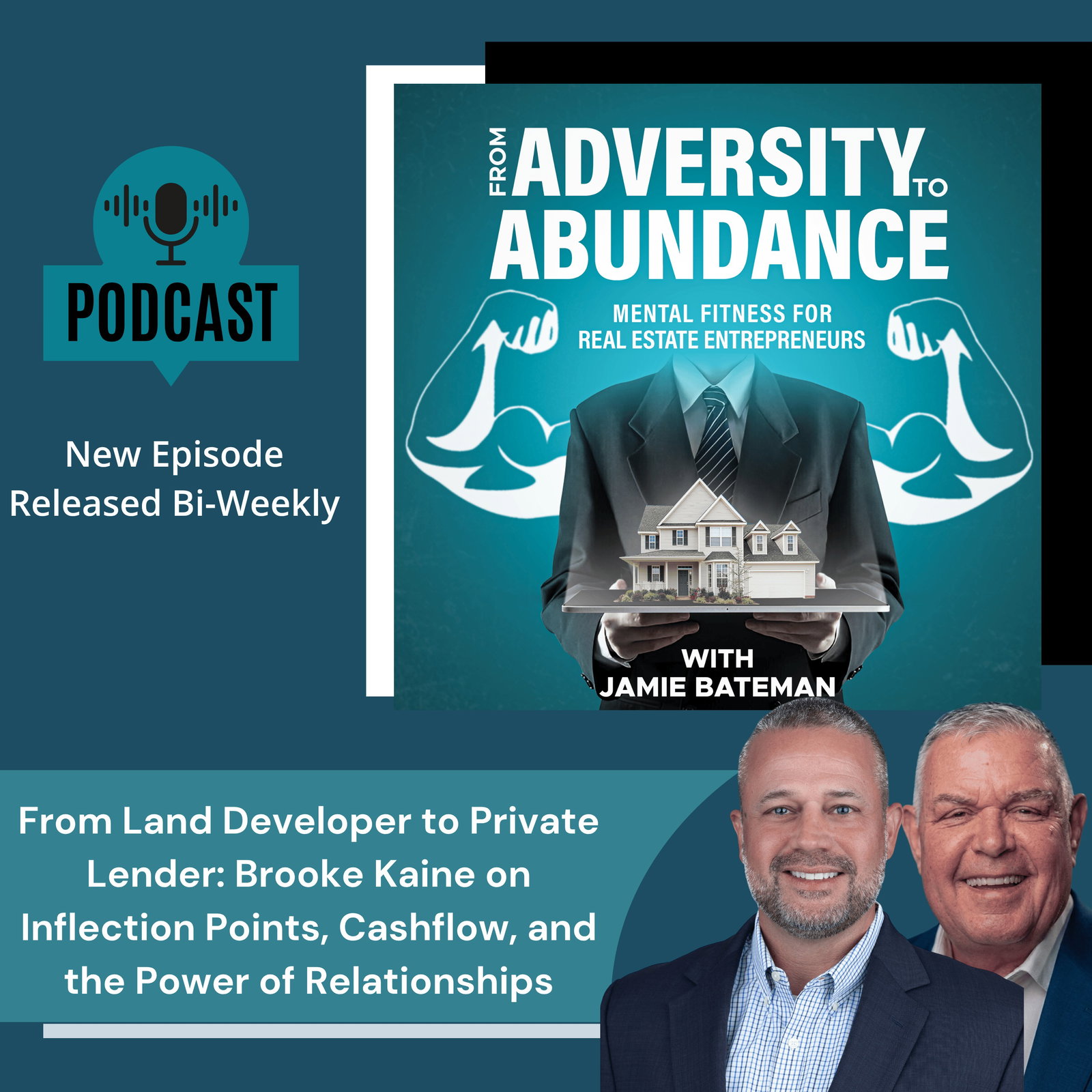
In this episode of From Adversity to Abundance, host Jamie Bateman sits down with Brooke Kaine, owner of Kaine Investments and a seasoned real estate veteran with decades of experience across land development, ground-up construction, rehabs, and private lending in Maryland. Brooke is the kind of guest who is as generous with his wisdom as he has been with his time — a self-described evangelist for private lending who discovered hard money about 13 years ago and hasn't looked back since. His story spans multiple real estate strategies, a pivotal geographic move that changed his trajectory, and a business model that ultimately gave him something more valuable than profit: consistent cashflow and deeply meaningful relationships.
But this episode isn't just about the mechanics of private lending. It's about the mindset shifts, the inflection points, and the hard-won lessons that come from living through market crashes, government overreach, and the quiet courage it takes to uproot your life and start over in a new city. Brooke brings warmth, candor, and a lifetime of stories to this conversation — and saves one of the most powerful observations about relationships and impact for the very end.
Guest Introduction: Brooke Kaine
Brooke Kaine is the owner of Kaine Investments, a Baltimore-area private lending operation he built from the ground up over the last 13 years. After decades in land development and home building in Southern Maryland, Brooke pivoted to hard money lending and grew his business from 20 loans in his first year to nearly 250 at his peak. Today he operates as a capital investor, lending to other hard money lenders while staying connected to the business he loves through relationships built one lunch at a time.
Episode Highlights:
- From Land Developer to Private Lender: Brooke shares how government overreach in Calvert County slowly strangled his land development business — and how a cold February night and one honest question from a friend pushed him to make the move to Baltimore that changed everything.
- The Power of Inflection Points: Inspired by a chance dinner conversation with a self-made executive, Brooke reflects on how the moments things looked the worst were often the very moments that launched the biggest leaps forward.
- Building a Lending Business on Relationships: From 20 loans to nearly 250 a year, Brooke breaks down how his entire business growth came not from Facebook ads or social media — but from showing up, nurturing relationships, and genuinely caring about the people across the table.
Key Takeaways:
- Indecision is still a decision — more is lost by waiting for the stars to align than by making an imperfect move and adjusting along the way.
- Cash flow beats profit. Consistent monthly income is what actually funds your life and lets you sleep at night — lumpy profits don't.
- Relationships are the real business. Word of mouth, trust, and genuine care for people will outlast any marketing strategy you can buy.
Connect with Brooke Kaine:
Phone/Text: 301-943-1407
Email: brooke@kaineinvestments.com
Are you an accredited passive investor?
Learn more about the Integrity Income Fund:
https://labradorlending.com/investors/passive-investors/
Purchase The From Adversity to Abundance Book:https://www.amazon.com/dp/B0CGTWJY1D?ref_=pe_3052080_397514860
Leave us a REVIEW:https://podcasts.apple.com/us/podcast/from-adversity-to-abundance/id1618672867?mt=2&ls=1
https://www.adversity2abundance.com/reviews/new/
Connect with us:
Website:https://www.adversity2abundance.com
Facebook:https://www.facebook.com/labradorlending/
Instagram:https://www.instagram.com/labradorlendingllc/
LinkedIn:https://www.linkedin.com/company/labrador-lending/?viewAsMember=true
YouTube:https://www.youtube.com/channel/UChYrpCUlqFYLy4HngRrmU9Q
Connect with Jamie:
LinkedIn:https://www.linkedin.com/in/jamie-bateman-5359a811/
Twitter:https://twitter.com/batemanjames
Speaker 0
Today, we sit down with Brooke Cain of Cain Investments. Brooke is a wealth of knowledge and a good storyteller as well, and it's just a kind, giving person. I had the opportunity to have lunch with Brooke about a month ago, and that was a fantastic, experience. And I I I asked him to come on the show to tell provide some inspiration and some practical value to the listener. He's been in land development, rehabs, all kind of ground up construction, primarily in Maryland, and done many different things in real estate investing over the the several decades. And, but he's discovered private lending or hard money lending about thirteen years ago or so, and he raves about it. So, we don't get too far into the weeds on how to do a hard money loan or how to do private lending, but his story, is just really fascinating. And he's clearly someone who wants to give back and, just he's just a a very generous person, kind soul you can tell. And, you're gonna wanna listen to this if you have any interest in private lending, if you have any interest in, you know, why that may be a better fit than other, asset classes or strategies within real estate investing, and if you just want general wisdom, there's something at the very end that he that there's just a powerful statement that he made, an observation that he's that he's made, from living seventy five years, you know, about the power of of relationships and, you know, the power of making an impact on other people. And, just I I really, really thoroughly enjoyed this conversation, and I think you will too. Speaker 1
From adversity to abundance, hosted by entrepreneur and seasoned real estate investor, Jamie Bateman, is the ultimate guide for active and passive investors seeking clarity, mental fitness, and the confidence to make inspired decisions in the world of real estate. With a decade plus of investing experience across various niches and a background as a combat veteran, former army officer, and multimillion dollar mortgage note company owner, Jamie brings a wealth of knowledge and inspiring stories to each episode. Through weekly episodes featuring insightful interviews with industry leaders and solo explorations of mindset and strategy, listeners will uncover actionable advice and tips to overcome challenges and build lasting financial success. Whether you're a seasoned investor or just starting, from adversity to abundance is your road map to turning obstacles into opportunities and achieving financial freedom. Speaker 0
Welcome, everybody, to another episode of the From Adversity to Abundance podcast. I am your host, Jamie Bateman. And today, we have with us Brooke Cain. Brooke is a Baltimore, Maryland area private lender, and he's done a lot of different things in in real estate. Brooke is the owner of Cain Investments. Brooke, how are you doing today? Speaker 2
Good day, Jamie, and thanks for having me on. I appreciate it. Speaker 0
Absolutely. I know you have a a ton of stories and a ton of knowledge and a ton of inspiration to provide to the to the listener. So, I think that the challenge here will be to you know, for me to be able to focus the conversation because there's so much. I feel like we could probably have five or six episodes, based on your wealth of of knowledge. But for the listener who may not be familiar with you, who are you today? What are you up to today, and and what is some of the abundance that you're experiencing today? Speaker 2
Today, I'm almost seventy six years old. I'm partially retired. I tried to go fully retired January first of this year and transitioned the business over to, one of our employees, Carrie Martinez, which we have done, and and and I thought I could really just step away, okay, which I can, but I thought I could really get away from the business. And that lasted almost to February of this year. Speaker 2
a month. Yeah. And then I said, I don't like this retirement even a little bit. So I kinda got more back involved a little bit with it, but, basically, we've transitioned from being a hard money lender, loaning to individuals, investors who are doing rehabs, resales, sometimes, rentals, buy and hold. Mhmm. And over the years, I've been blessed with having, helped other people in some small way small ways get into the business, mainly through inspiration and having lunch with them at Deepest Quality. Mhmm. Yeah. Did a a few Like we did. And inspired them to look at the business because I'm such a an evangelist and and and a believer in the business. Mhmm. And so I've started transitioning away from lending to individuals and lending larger amounts to these, hard money lenders like I used to be. So I'm more you might describe me now as more of a capital investor. I think that's a term that's Yes. Kinda used in the industry Yep. Than a direct hard money lender. Okay? Speaker 2
I lend to those lenders. Okay? And it makes the business a little simpler. You don't have because it we had, like, forty five, fifty borrowers, you know, checks coming in every month, and it's a lot of management. Okay? Now we have seven or eight, nine checks coming in. So Okay. That's where I'm at today. Speaker 0
Okay. Perfect. So and to be clear, you got drawn back into some level of of of active investing, but that was primarily because you didn't like retirement. It wasn't so much that you know, I I don't wanna say the business didn't need you, but it was more that you didn't like retirement. Is that fair to say? Speaker 2
Yeah. I needed the business. I needed the action. Alright. I'm a I'm kind of an action guy, and and, I miss the action. Yeah. Okay. I miss the making deals, solving problems, coming up with new ideas, hearing stories from other people. That's the big deal. As you know, I enjoy, you know, meeting people at lunch. And, you know, I was gonna say, well, after a while, they don't wanna hear about my investment in the stock market. And, you know, you know, I I Right. I got no if I don't have stories to tell, then then well, good. Why do you wanna have lunch with me? Speaker 0
I don't know. That was a pretty good, Italian cold cut and and Yeah. That's true. Speaker 0
Conversation is what what made it. But, you know, I guess you know, you can be as specific as as you want, obviously, but, how has real estate investing and, private lending made your life more financially abundant? Speaker 2
Straight up, with the businesses that I've been in all in real estate, whether it's land development, home building, rehabbing, whatever phase, I have never been around. Now, again, I didn't graduate from Wharton or Harvard Law or any of that kind of crap, but I I'm saying it's a good Yeah. Right. Wish I had. Right. But I don't mean it negatively, but I just didn't have that opportunity. But of the businesses that I've been associated with, nothing nothing, you know, has made two things. One has made the cat has made the income Mhmm. With what I feel is exceptionally run right, run conservative, run tight Mhmm. A very constrained risk profile. Okay. Because that's the first thing people will ask you. Oh, man. Isn't that risky? Well, if you if you don't pay attention Speaker 2
don't do the right kind set up the right kind of bit yeah. It can be. Right. Okay? Sure. But I've not been around a business. And, again, when I first came to Baltimore, I had no idea what hard money was. I didn't know what the term meant. Right. I thought, well, shit. Every bit of hard money every money bit of money I ever made seemed like hard money to me. And when I got to know the business more, it it be it it it it was phenomenal from a cash generation stand income Mhmm. Mhmm. Standpoint Right. Coupled with, you know, having very constrained risk. Speaker 0
Yeah. Yeah. Okay. Speaker 2
Very constrained risk. Speaker 0
Got it. Well, it sounds like you could have retired years ago, but you love it too much, basically, is what I'm what I'm gathering. Speaker 2
You know, I I love how it it inspires and perpetuates great relationships. It's a great Because you're you're you're involved with people's business. Let me turn this damn thing on. You're involved with people's business. When you get a certain amount of gray hair and then the calendars have flipped a certain number of times, people listen to your stories like you know something, which makes an old guy feel really good. They they actually listen to what I'm saying. Right? Right. And some of that's based on on advice and hard knocks and and all that. So Yeah. It makes me feel good Sure. For sure. But it it, I've just found it to be Mhmm. Really, for me, with my frame of reference, a a fantastic business. Speaker 0
Nice. So it sounds like you've got a lot of time freedom and financial freedom, at at this point. So but I know it wasn't always that way. So let's jump back and and discuss some of the particularly the downs that you've been through, and maybe, you know, I think you have a potentially a story, to tell about someone else's story, actually, to tell. But, talk about some of the hardship that you've been through in your background, you know, maybe whether in real estate directly or otherwise. Speaker 2
And I'll I'll use that story we talked about before we jumped on the air or Yeah. Yeah. Started recording. And this was a friend of mine in Florida, and we had a place down there at the time. This was in the early, I don't know, eleven, twelve, something like that, or or, actually, even earlier than that, o eight, o nine, as I look back. And this guy, it was a cousin of my friend, and we had dinner with him. Nice guy. Okay. Very transparent. Mhmm. And he was a player. I mean, he was president of I forget the gentleman's name, but just a great guy. Some big corporation, and that was a big supplier to parts to GM and and and so the guy had done well. Sure. Started in a garage fixing alternators in Alexandria, Virginia. Okay? And I asked him I said, what were those times in life, you know, where you really because he jumped up, and we went by his condo, and his was much more handsome than mine was. So Nice. He had done very, very well. Yeah. And I said, what let's call the guy Dan. I said, Dan, what were those moments in your career looking back when you made those jumps? In other words, when you went from a to z. I mean, you you really made those to get from a busting up alternators. That's a part of an engine, I believe. Yeah. In Virginia to to this, you know, to where you are today. And he says that's a great question. And when I look back in that context, what I found what now that I think about it, the times where I made those, I'll call it, meteoric, you know, substantial jumps Speaker 0
Right. Like a bay like an inflection point or some kind of, like Speaker 2
That's a perfect that's a perfect way to put it. Was at the times things look the worst. Okay. And he went on to tell some stories. You know, he sold his business, you know, at a fairly young age. He built it up, bunch of money on the takeout, took a lot of it back in stock. These guys ran it into the ground. He said, jeez. I have to come back in, and it was the best thing he ever did because he bought the stock back at a at a you know, it wasn't worth much. Mhmm. And he bought it back, got those guy, and then it just took off. And then there was two or three of these inflection points, like you say, Jamie, that made all the difference. And I'll never forget that story because this was before we had decided to come to Baltimore Okay. Which we did in August of eleven. You were you Speaker 0
were down in Southern Maryland? Speaker 2
I was in Calvert County. K. You know? Compared to Baltimore, a galaxy far, far away. And if you're in the growth business, you know, like build houses or cut up ground, do not, under any circumstances, go to Calvert County. That's funny. It's because so we had been in the building to biz my dad had been in the business. I got into it. You know, basically, it was a simple dynamic. We would buy a farm or woodland, whatever, a piece of ground, hundred, two hundred acres, cut it up into lots, subdivide it. Speaker 2
What they call down there developing. You know, up here, we use developing with different terms. Okay. And then we put the streets in and all that stuff and build the houses. Okay? And then go find another farm, cut it up, boom, same process for instant repeat. Speaker 2
And we grew it. We were only doing twenty five, thirty houses a year, but down there, that's quite a bit. Mhmm. And, you know, but it got more and more difficult, not because of market. Not I could handle market fluctuation. Didn't like them, but that's part of the deal. Sure. I could not beat government. Government got worse and worse, and the people that moved to Calvert County Mhmm. Okay, are people that don't want change. I mean, inherently, none of us want change. I got that. Change. Right. Right. Right. Sure. None of us we all like the settings. That's
Speaker 2
Yeah. Okay. But what I ran up against was that these the, the politicians, the local county commissioners would run on a no growth platform. Okay? We're no more traffic lights, no more people, no more growth, no more, no more, no more. And that was a very compelling argument for votes because the people that came down there wanted to get away from us. So each I see. And every administration would take another bite out of the growth apple and made my life more and more difficult often changing the rules after you bought the ground under one set of rules. Wow. And in the meantime, you know, you got new changes because they all wanna take a chain you know, to say it happened on their what. Right. Right. Government, while it didn't put me out of business, I realized in o seven zero eight, not just because the market was the projects I was working in. I had about four different communities. Mhmm. And not one of them not one of those communities and I developed all of them. You know, I cut the ground up and all. Not one of those communities could I could I cut lots up in under the existing rules that I was facing. So every lot that I sold Mhmm. Was like going into deep as well as and grabbing out the last bottle of olive oil off the shelf. You know, eventually, you're out of the Italian market business. Right? Right. Right. I could see you know, I was, was it fifty eight then? Fifty nine? Yeah. I was born in fifty. I could see, you know, you're thinking about retire not retirement, but just how this gonna wind up when I can't Sure. Yeah. Run anymore.
Speaker 0
Yeah. You're looking forward. Yeah. Sure.
Speaker 2
And it didn't look good. Didn't mhmm. Okay? I mean, I wasn't gonna go broke, but I sure as hell wasn't gonna be, it it was gonna be difficult. Mhmm. Okay? Sure. And I said to the same you know, it it got to be, like, February. I'll never forget it. February of eleven. Mhmm. And I was in bad shape. Mentally, the market was bad. You know, the business was going okay, but I I could see down I couldn't not see further down the road. And when I did, it made me you know, I'd walk in the floors. Okay? And I'll tell you, this is honestly got the same guy who introduced me to his cousin
Speaker 2
Yeah. Ben Walker, was over for dinner one night, cold February night. K. And I had been looking at different places to get out of Calvert County because that's the only place I was in. And I went to Saint Paul School as a boarding student up here in in Baltimore. My wife's from Pikesville. So we had some Baltimore connect. Mhmm. And I I said, Glenn, I said, I gotta get out of here, man. I said, they're killing you know, I'm I'm I'm gonna die on the vine. And I really think I wanna go to Baltimore. Mhmm. I don't know what it entails, but they gotta have more lots up there, more people up there. I don't know what them will do, but there's gotta be better than here. Speaker 2
And I'll never forget he says, what's stopping you from moving now? And I just and I knew what's stopping me, and it was guts. Two weeks later, I bought the house over here on Alice Anna. Okay? Okay. And and and we moved six months later after it was rehabbed and everything. Okay. Scared it. And that was my moment that I related so well to the guy we had dinner with three or four Speaker 0
Well, it sounds like Speaker 2
I was afraid. I was scared. It was a low point. Speaker 2
But it became it it it just became, all I would not be here where I am today Yeah. Had Glenn not not called me out. Right. Speaker 0
Well, I think that's that's there's so many things, you know, takeaways from that story. But, you know, we need people in our lives who will challenge us sometimes, you know, peers and friends and, you know, fellow investors, whoever it is. But, you know, it's, that's that's has a lot of value to it for sure, but you needed to be open to hearing it too. You know? Speaker 2
Well and and sometimes you've gotta just hold your nose and drop off, you know, jump off the end of the board. Yeah. Okay. Well, talk Speaker 0
about that for a minute because it's not you know, I have my own opinions on I I don't think there's a science to this. Right? You know, when should some someone take that leap and and make a change like that in their in their life? I mean, you on one hand, you can't wait for the stars to to all align. But on the other hand, you you don't wanna be, you know, too too risky. Right? So how do you know when whether it's quitting a w two job to go to go into your own business or whether it's making a move like you did geographically and and then into a different, real estate industry, really, a different, strategy. How do you know when that's the right time, you know, it's the right time to make that move? Speaker 2
If you wait until the stars are lined up Mhmm. Just understand that's gonna be too late, whatever the time frame is. It's never people are risk aversive Yeah. By nature. They are risk aversive. People want constant. People want the status quo. It's just human nature. Right. So it's never gonna be easy. And I will maintain the greater the risk, the greater the reward. Okay? Not everybody can buy into that. Okay? And I grew up with or, you know, my dad was in the real estate. I mean, so I I was more comfortable with risk maybe Mhmm. Yeah. Than than a lot of people. But, nevertheless, at the time, it it it I also learned at an earlier age that more is to be lost by indecision than a bad decision, and I'll explain why. Yeah. Indecision is where most people are, and I and I'm not saying anything wrong, but it it's just human nature. Speaker 2
But I found that when you wait and and and some people say, well, I'm not gonna decide to do that today. Mhmm. Well, they think they haven't made a decision. Yeah. You have. You've made a decision. You're not gonna get out of that. Right. You've made a decision not to decide. That's a that's a great point. It's a decision nonetheless. It doesn't feel like it because it doesn't hurt as much as as taking the risk. Speaker 0
Yeah. I actually, I've been, just I don't wanna get sidetracked and No. Don't wanna but I've been watching for whatever reason, my YouTube feed's been had a lot of, videos about religious debates, debates about religion. I should you know? And it's just interesting because the truth is if you are an agnostic or an atheist, and we're not we we're not we don't need to get too far into this, but you've made a decision, at least for now, Speaker 2
about what you believe. Speaker 0
So, that it just that's a that's a great point. Speaker 2
And what I found, you say, well, Jesus, if I make, a bad decision, if I make too quick of a because a lot of people say, well, I should have thought it over more. I I Right. Right. Look. Most decisions can be pulled back. You can correct. This isn't like, hey. I'm gonna decide to put the noose around my neck and ask the guy where do I stand so you can drop me clean. No. It most decisions can be modified, shifted, or something. It's not the end of your life or the world. Right. Okay? So much more is to be lost by trying to overthink it, you know, microscope type stuff. Mhmm. Do it. And I know that's easy to say. Right. Right. If you don't do it, don't expect great wins to come your way. It just won't. Speaker 0
There's a lot of opportunity cost there. Right? If you if you, you know, make a decision not to make a decision, basically, then then you're not or make a decision not to take action, what did you miss out on that you could have gained? Right? So so when you moved to Baltimore, what changed for you with your perspective, your business? How did things change over the the course of the next ten, fifteen years? Speaker 2
I came up thinking that there were more lots, in the county, more opportunities there. So I bought some lots out of foreclosure with, I think, M and T Bank had taken some back from a guy. Okay. So I bought some lots, and then I hooked up, with a young man, Tyler Banks, very good friend to this day, and we formed Charm City Builders, which is basically a rehab company. Speaker 2
And I was funding him. Speaker 2
One of his his primary funders. Okay? I had another person who was a superintendent for me who built the houses. These case were townhouses out in the county. And so I was gonna run a inside and outside, I called it. You know, in the city with rehabs, the typical row house situation. Mhmm. And then new stuff on the outside because I had access to more ground than I did in Coward. Okay. And then, I started to understand that whether you're building up here or in Calvert, it's the same I didn't want that business anymore. Right. The rehab business wasn't too bad, especially where my side of it was basically in the funding. Right. Right. Right. Speaker 2
and then I'd put up the money. He'd find the house. We'd build it. You know, he would oversee the construction. We split the profits when we sold it. I made, like, I was charging six percent on the money because I had to have somebody move it around. I wasn't doing the accounting. Christine, my second, was was doing that, and I need some kinda offset for her cost. But I found after two or three years, some of the deals, I made more on the six percent than I made on the split and the profit that didn't exist. Right? Okay. Yeah. I got used to, you know, understanding that there was another world out there called this private lending. Mhmm. And I started started to see some of the returns that these guys were making. And I look back on my own experience in land development and home building. And even though I lost monies like Buku and certain land deals or houses or whatever Mhmm. You know who never lost? The bank. The bank. Yeah. Lost. Speaker 2
Oh, Jesus. That's the business. So that, I made my first non Tyler loan, you know, because I was exclusively lending to him Yeah. In April of fourteenth. And we did twenty that first year or so. And I finished up my last year that I was actively involved in it before I turned it over to Carrie. I think it was twenty four. We did, like, two hundred and forty loans. I mean, the thing blew up. Wow. Okay. And That's awesome. I I will tell you to this day, I it seems that most of that business came off the tables with deepest qualities because that's where I would Okay. Meet people. That's where I would develop relationships that developed into lending relationships. Speaker 0
Yeah. Well, a couple of things I wanna ask about. Well, first, you know, so how did your perspective change? I mean, from that February night when you were really down and out, I mean, it's more than one night, but Yeah. You were sounds like not in a good place, you know, financially, but probably more importantly, you know, mental health wise and just perspective on the future. How did was it what really, what turned that around? Was it, you know, was it a how did that all happen? Was it over the course of time, or did you change your mindset and then the, you know, the the money started coming in? Or how how did that process look when you look back? Speaker 2
I had a few bucks that we came to the up to to the city with. That's what I was using with Tyler. You know? Tyler and I were were Right. And then I said, hey. I think I wanna do more you know, I'll still continue to fund you Yeah. But not exclusively. And I I ask her out of deepest quality. Okay. Anybody else need money, and a lot of hands went up. Speaker 0
So I imagine as traction was you got traction, then you got momentum on the private lending side, and then then it's easier to see the future. Right? And you're seeing more abundance in your own your own life, and you see this business model working proof of concept. So, that's that's that's really cool. So, alright, so how many years did you have you done private lending for approximately? Speaker 2
Call it fifteen, two thousand fourteen and a half, two thousand let's say fifteen. And okay. It'd be, like, from fourteen to where we are now. Sixteen twenty six. So what's that, twelve years? Speaker 0
Twelve years. Yeah. Twelve, thirteen years. Yep. Something like that. Okay. Speaker 0
Alright. And now and and, you know, you know, we do mostly first lien mortgage notes. We buy defaulted paper. We also buy reperforming loans. We buy some seconds. We bought bought some land notes. But I'm a note buyer, and I'm looking at getting into private lending. This isn't just hypothetical. Wanna start building that side of things as well. The the new thing for me and for probably a good number of my listeners is so I run a a note fund, and the three elements really to running a note fund, the three legs of the stool are, finding capital, you know, raising capital, finding deals to buy, finding notes. So, you know, and then we we there's a whole process there. And then the third leg is is managing those two things, so managing the capital and managing the assets. It's really no different. You know, if you zoom out, it's really no different on the private lending side, except when you zoom in a little bit, the you gotta find borrowers. You're not finding notes to buy, so you've gotta find borrowers to lend to. So I think I know the answer to this, but what what was your main strategy to finding borrowers to lend to? Speaker 2
The overarching reality, at least from Speaker 2
Was that deals find deals find money. Speaker 2
Okay. If you have money Speaker 2
Whether it's borrowed from capital investors, people like me at this point in my career Right. Or your own cash Yeah. HELOC on your house, a reasonable HELOC, reasonable HELOC on your house Speaker 2
IRA money. Okay. Whatever source, you've got money to lend. Right. If you put yourself out there Mhmm. Okay, letting people know that you've got money to lend Mhmm. Believe me. It's like mosquitoes, you know, on a on a warm Sunday night or a warm summer night. Right. Right. They'll find you. They'll find you. It doesn't mean you have to you still have got a vet. You still have gotta nurture the relationships in the way what you wanna do is work with the same people over and over and over again that you like trust and respect. Yeah. And that's how you, you know, you build the business up, and they like, trust, and respect you. Yeah. And you've got a strong relationship. Well, yeah. You are It's less it it's more of a challenge of finding the capital to lend Okay. Than it is finding the borrowers to borrow. Okay. Speaker 0
Yeah. Because At Speaker 2
least that's the way it's been for us. Speaker 0
Got it. Yeah. That's a probably that debate will never never die as far as Speaker 0
real estate world, you know, which, deals fine. Deals attract capital or capital attracts deals. But what I heard from you too is is it's a relationship business. And, I mean, that's it it sounds like just through your lunches that you schedule, but also just word-of-mouth and just everyday conversations, you're just, like you said, putting yourself out there. It's not a ton of marketing. Right? Like, actual, paid marketing or unpaid marketing. It's more just kind of, you know, word-of-mouth. Is that fair to say, at least from your experience? Speaker 2
You know, yes. And that sounds overly that sounds like an overly simplified answer to that. Mhmm. But I look back. I I the only thing I can tell you is how we grew our business. Right. Right. Or how our business grew Speaker 2
On game. Right. Because it sounds like when you say how we grew it, sounds like their Facebook or or Mhmm. Truly, now we have a Facebook thing. We got a website. Somebody said, like, couple years ago, it was down for six months. We didn't know. That's funny. That that has not been. Outreach has not been the source of our growth. Speaker 2
You say, well, what has? Right. The only other thing that we do is nurture those relationships, And and I and I swear, I look back on it and yeah. Oh. Yeah. It's deep it's I mean, that's the only thing that we've done consistently. Yeah. And we don't do it because, hey. I'm gonna have lunch so I can get a deal. Mhmm. No. I wanna meet people and hear their stories. Right. And and out of that, If Speaker 0
you can help each other out, then things like Speaker 2
that. Yeah. Yeah. That so if you say marketing, which is very labor intensive and time intensive Sure. All that. But I don't know what else did it. I don't think it just grew Right. Because we had access to money. Right. I think that didn't hurt. Right. But, I mean, we went from twenty to two hundred and almost two hundred and fifty loans. Yeah. That that something went on. Right. And it wasn't Facebook or media or social media or any of that. I can tell you it wasn't that because we didn't spend any money on that. Speaker 0
Yeah. I've I've had the same experience in my own business with you know, I do mentorship for newer node investors, and a lot of them struggle to find deals initially even though I'm trying to help them find deals. But, it's because they had they don't have the the relationships yet because, you know, that's my primary source of of notes is fellow investors and people I bought from before, and it's just my network. And then same thing on the capital side with our fund investors. Our our, you know, strongest or most fruitful source of capital is actually our current investors, and maybe somebody somebody they recommended you know? Right. Recommended us too. You know? And we do marketing, but I be because people will Google you, and they'll they'll they wanna see that you're out there. And, you know, it's one of the Speaker 2
things that you some kind of presence. Exactly. I understand. Right. Speaker 0
But that's not people don't just see a a an Instagram reel and then send you money. At least that No. Hasn't been my experience. Speaker 2
So No. I think you've gotta be face to face, and I like when there's a a real Italian sitting in the middle on the table. You know? That that that's a great sandwich. Speaker 0
It sure is. Absolutely. Okay. So I do have some, some questions for you. Some additional questions that I we we ask, you know, other guests. But before we get there, where where's you already talked about your business now. Where do you see your business headed in the future? Speaker 2
I'll continue I'm happy again. I wasn't happy in January as long as I can still bring value. And I don't mean value in terms of dollars Mhmm. But in terms of advice or insight or ideation. Mhmm. You know, at some point, you know, mentally you know, age is is what it is. And where when I reach that point, whatever it is, health wise or mental or physical or mental, then you you you give it to the wealth adviser. Okay? Stock guy. Right? Speaker 2
And and you you hang up your spurs. I mean, because you can no longer deliver, value other than just money. Right. Then I would probably step away, you know, from what I'm doing now and be even more passive. Got it. Well And I probably wouldn't know I'm doing it. So that at that point, I'm fine. But right now, I'm gonna run it as long as I can Mhmm. That I that I can provide help for people, and make a buck along the way. Speaker 0
Okay. How about for private lenders in general, you know, who maybe they're in a different market, but, what's changed over the twelve, thirteen years you've been doing private lending, and where do you see things going in the industry? Speaker 2
I see, even though the business is very fragmented now, there's a you know, the vast majority of private lenders, hard money lenders, whatever you wanna call them, them, are smaller operations, but there's more and more, lenders that, you know, have a national presence, and they're getting bigger. Mhmm. I still think there will always be a market out there for private lending Mhmm. Of whatever size you wanna make it. Whether you got a hundred thousand, half a million, or or ten million, they'll they'll be someone that wants money Okay. That wants the convenience of dealing with a human rather than a bank. Right. Can can deliver speed because that's basically what we sell. Speaker 2
You know, turning of the money, providing the funds in a timely fashion, that type of thing. I still think there will be that. I eventually see, and it's not yet. There's some talk, in New York where you have to get licensed if you do loans of less than half a million. Mhmm. And the licensing thing is where the regulation starts. It starts as a licensing. Mhmm. You need to get a license. Now we can track you. Now we can write regs against that and tax against that and fees against that. Mhmm. And we need to have your loan looked at by a government official. And now right now, the most beautiful thing because my frame of reference is government tried to put me out of business. Mhmm. And there are no builders in Calvert now. One guy's got a few lots left, but that's it. I think you're going to see more regulation in the private lending space. Mhmm. Okay? When is that coming? I don't know. Is it coming? It's too much money in flow now. There's too much money out there for it not to be looked at by government. Speaker 2
So that I see. Mhmm. But it's gonna be a while before that becomes punitive like it became on the the growth side. Right. The growth in in in in, like, land developing, things like that. Mhmm. But it it's there's still a lot of opportunity. There's more people in it, and I haven't helped that situation by encouraging people to get it. You know, people have asked me, said, why are you getting all these guys in the business? And, you know, aren't you creating more competition? That's one way to look at it. Mhmm. Okay. The other way is that you're helping other people, and if you work together, you know, you give, but you get. I mean, it it Right. I don't see that as competition. I see that as push paying it forward. I found a great business. You should look at it. You know, and, again, I I talk to mainly people that have some real estate experience. So it's not like Right. Speaker 0
Yeah. And the reality is, honestly, at least from my experience, most people are not going to take action. So, you know, so, you know, same thing with with my mentorship. It's like I mean, it's not not I mean, it's not a bad thing necessarily. Speaker 2
Not a bad thing. Speaker 0
It's it may not be right for them. Right? But, I'll have people do a few sessions with me, and then it's like, this is more more work than I realized, you know, and this I don't have time for this. That's well, they learn. Speaker 2
That's too late. Great. Great. Absolutely great. Speaker 0
So okay. Awesome. Well, I mean, this this is, it's been really good. I got got some rapid fire questions. Some of them do trip people up, though. So are you ready for them? Speaker 2
Okay. Rock and roll. Speaker 0
Alright. What is one thing that people misunderstand about you, Brook? Speaker 2
My, my obsession with paying it forward. And it came from a book called The Go Giver, okay, which I you know? Speaker 0
You did. You gave me a copy, and I read it. I'd I'd it's been recommended on my show before because that that's one of my questions is what is the book that you can recommend? So Speaker 2
Yeah. That that early on the the books that I recommend are are two of them that I discovered in my early twenties or my my twenties. And because I fell in love with Dale Carnegie. I I thought some of the courses. I I the management course, the sales. And the the two books, you know, one both of which were written in the thirties, How to Win Friends and Influence People, and That's Speaker 2
a companion, book called How to Stop Worrying and Start Living. And I found both of those. And then the next book was in two thousand six when a consultant I was working with, in Calvert, and he recommended, The Go Giver. And that just and people, I think, sometimes don't understand, you know, why are you doing these things? Right. Why are you giving me your forms, your advice Right. And setting me up in business? Right. Yeah. Because it feels so damn good to help people. That's It just does. Yeah. It does. I mean, and if you don't appreciate that or you see it as competition or why should I help the other person, they haven't done anything for me, I that book will get you past that. Mhmm. And and paying it forward is nothing back when they used to do, you had toll booths instead of the readers and stuff when you got the Yeah. I I started doing these things called racks, random act of kindness. You pay for the toll of the guy behind you. Right? Yeah. And sometimes you have to look in the rearview mirror to see the shock and understand. Right. But I look at, you know, helping people Yeah. Not just in the money business, but anything that you've got that can help the next person do better. Right. I think it's your obligation to to to to to just keep pushing it out there. Speaker 0
No. I mean, I don't I I I take issue with the whole self made millionaire thing, to be honest with you. It was like nobody is self made No. To to to just keep pushing it out there. No. I mean, we do need to take ownership of our own situation. Right? And and your own thoughts and actions play a big role in things for sure. But if anybody who's successful in any way had some help along the way. Speaker 2
Absolutely. And so people will misunderstand my motivation for helping. Speaker 0
Yeah. Yeah. Makes sense. If you could go back and give your eighteen year old self some advice, what would that be? Speaker 2
Learn how learn what a balance sheet and an income statement is. I didn't know what they were till much, much later in life. Yeah. And I did not know this is from a business standpoint. Speaker 2
I did not know until I was in the hard money business the power of cash flow. Speaker 2
Okay. Not profit, not depreciation, not any I'm talking cash flow. Okay. And I struggled so heartily with that Mhmm. Mightily in the building business because you'd have big lumps. And you do twenty five, thirty deals a year. You know, you'd have good cash flow, and then you'd starve to death till the next settlement type. Right. But that the power of consistent Speaker 0
Consistent cash flow. Cash flow. Speaker 2
Yeah. I think out now I'm not an accountant. I like I said, I didn't learn to read things till much later. Speaker 2
But now that I've lived it Mhmm. I would almost rather have flow than profit. Speaker 2
Okay? I mean, obviously, at some point, you have to have profit to generate flow. But Right. Right. You can have profit and not flow, and you're gonna be broke. Okay? Because I always say, look. Because people will come to me and say, look, man. I need some short money because, you know, I I got settlements coming next week. Speaker 2
But they haven't come in yet. I said, look. Right. The minute you can't pay your bills, your people, whatever it is on Friday Right. You're out of business. I don't give a damn what you got coming in next week because that's not certain. What is certain is that you can't make payroll on Friday. You can't pay that bill on Friday. You're out. Speaker 0
My my father was a real estate agent for many decades. He still is, but, you know, and he did he did well, but there were many times because it's all commission based, you know, and and it's it's a lot of ups and downs. There are many times it was very tight. So, you know, stressful and then great and then stressful. And Speaker 2
Oh, I've lived it. You know? And I saw my dad live it. And Yeah. The money business, as you get it rolling, you know, the one or two loans ain't gonna get you to the happy place. But Yeah. As you grow it and get the thing going, it doesn't take, like, two hundred and fifty loans either. Does not. Does not. But it has better regularity of flow. Mhmm. And that flow is I can tell you from living the majority of my having the majority of my career where I didn't have that consistency of flow and now do Mhmm. I understand you can literally take that to the bank. Mhmm. Yeah. Okay? And and I think there's nothing more important for for a good night's sleep Mhmm. Than consistent positive cash flow. Speaker 0
Yeah. And and you must that that's really where you are now because you're lending to the to the lenders. So you you're not even you're not doing, like, the points and, you know, extension fees and stuff like that. You're basically just this is this is I get x percent interest on this money each month. Right? That's that's Yes. Okay. That's that's great. Yes. Awesome. Well, what how about something controversial that you see in the industry? Does anything stand out when I say that? Speaker 2
There, recently in Baltimore, there was a lot of fraud. Right. Yeah. Speaker 0
Heard about that. Yeah. Speaker 2
Yeah. The appraisal thing. There there's some opportunity for unscrupulous players. Mhmm. There there people say, well, hard money is risky. I'm not gonna say it isn't. I mean, there's a risk there. Mhmm. But managed correctly, it's far less than what I've experienced in other businesses. Mhmm. You have to you have to be careful, and and it invites people in to take advantage of other people. But Mhmm. Yeah. I found in my life, and I know this sounds noble, but most people you can trust. Mhmm. Most people are trustworthy. Right. They just are. There's some bad actors. Are you gonna get stung every now and then? For the returns that you're getting in this business, yeah, you're gonna have a a few bumps. Right. But, run properly. You're not gonna get stung too many times. Yeah. But there it it does invite. But banks get stung too. I mean, so we we can't avoid it. Yeah. So go ahead. Speaker 0
Yeah. No. If you we're almost out of time here. If you were given ten mill ten million dollars tomorrow, personally, what would you do with it? Speaker 2
I'd get on I'd pick this up right here. Mhmm. And by the time, one o'clock came along, I got that on the street. I can make call. You know, I can find Speaker 0
a home for people. Yeah. Speaker 2
Call my call my guys. Who needs? I know they need money now. Okay. I know that. I know which call it. Speaker 0
Do more of what you're already doing. Speaker 2
Hell, yeah. Nice. Why wouldn't I? Awesome. Speaker 2
are people say, well, you should diversify. You should you know? Okay. I'll worry about that next time around. Speaker 0
Yeah. We've already hit several of the other questions that I have just just, organically, naturally with through the conversation. So this has been been really, really good, Brooke. What's one question that you wish I'd asked that I haven't? Anything we haven't covered? Speaker 2
I don't think so. I don't know. That's what I can think of right now. I mean, there'd really be a million other ones. Yeah. But, I've enjoyed this. Thank you very much for for asking the old guy, you know, to tell some stories because this is the, at this point in my life in particular, the it's the money is great. I understand that. But the relationships Mhmm. The money pales in comparison to the opportunities we've had in Baltimore to create really, meaningful relationships. Speaker 2
And I'll leave you with this this comment because when I retired, you know, I called all these guys and said, look. In a year, I need my money back. You know? I'm going out of bed. I just you know? Because a lot of people were saying, it's at this point in your life, Brooke, it's you should think more about preservation than accumulation. Mhmm. But I can tell you having lived it for thirty days, there is absolutely no fun in preservation. Accumulation is where you wanna be. Speaker 2
But I think the the the power of the relationships give your life a richness that supersedes anything else that I've ever experienced. Wow. Okay? Yeah. And when I made those calls, I had three or four of these folks that we've helped and and lend to and and and and nurtured and and and one gentleman called me and said, I just you know, when I said I was retiring, he said, I want you to know that you have changed my children's life, my wife's life, my life, my family's life forever, and I will be forever grateful. Speaker 0
That's amazing to hear. Speaker 2
And I had three people call me like that that I've I mean, I don't know how much better you want it to be. I mean, after the call, I I broke down. You know? I mean, I I it I mean, it just gave I mean, I don't know if there's a a richer reward in life Right. Than to have someone make that statement that you have changed the trajectory. Speaker 0
That's incredible. Speaker 2
I don't know. It it it it it was no I've never made money or had a greater satisfaction than having the I mean, it it was Yeah. Speaker 0
That's that's that's a fantastic, final thought. That's really, really good. So Yeah. If if somebody does wanna reach out to you, Brooke, what's the best way to do that? Speaker 2
My email just my phone number is is is great because I you text or whatever, and that's three zero one Mhmm. Nine four three Mhmm. One four zero seven. Speaker 2
Okay? And just text me, or, I'll get back to you. You know, hopefully, I can help. But, I I I enjoy these these conversations immensely. Speaker 0
Sounds great. I know you've you've already been very giving to me over the couple months we've we've known each other, so I appreciate that. So and and, we appreciate you spending your time, over the last, forty five to sixty minutes, whatever it's been. So appreciate it. Thank you so much, Brook. Speaker 2
Well, I appreciate you having me on, Jamie. It's great meeting you, and I look forward to helping in any way I can. Speaker 0
Sounds great. And to the listener, thank you for spending your most valuable resource with us, and that is your time. Thanks, everyone. Take care. Speaker 2
Have have a good day. Speaker 1
Thank you for joining us on From Adversity to Abundance. We hope today's episode has equipped you with valuable insights and practical advice to elevate your real estate journey. For more inspiring stories and resources, visit us at w w w dot adversity to abundance dot com. If this episode has inspired you, please share it with a friend who could also benefit from our conversation. Together, let's turn adversity into abundance. Until next time, keep building your mental fitness and your real estate empire.