Does it sound familiar to feel stuck in a cycle of adversity and challenges? You may have been told to simply stay positive in order to overcome your struggles, but that advice often falls short, leaving you feeling frustrated and hopeless. The pain of trying to maintain a positive attitude without seeing any real progress can be disheartening. But there is a better way to achieve resilience and a growth mindset.
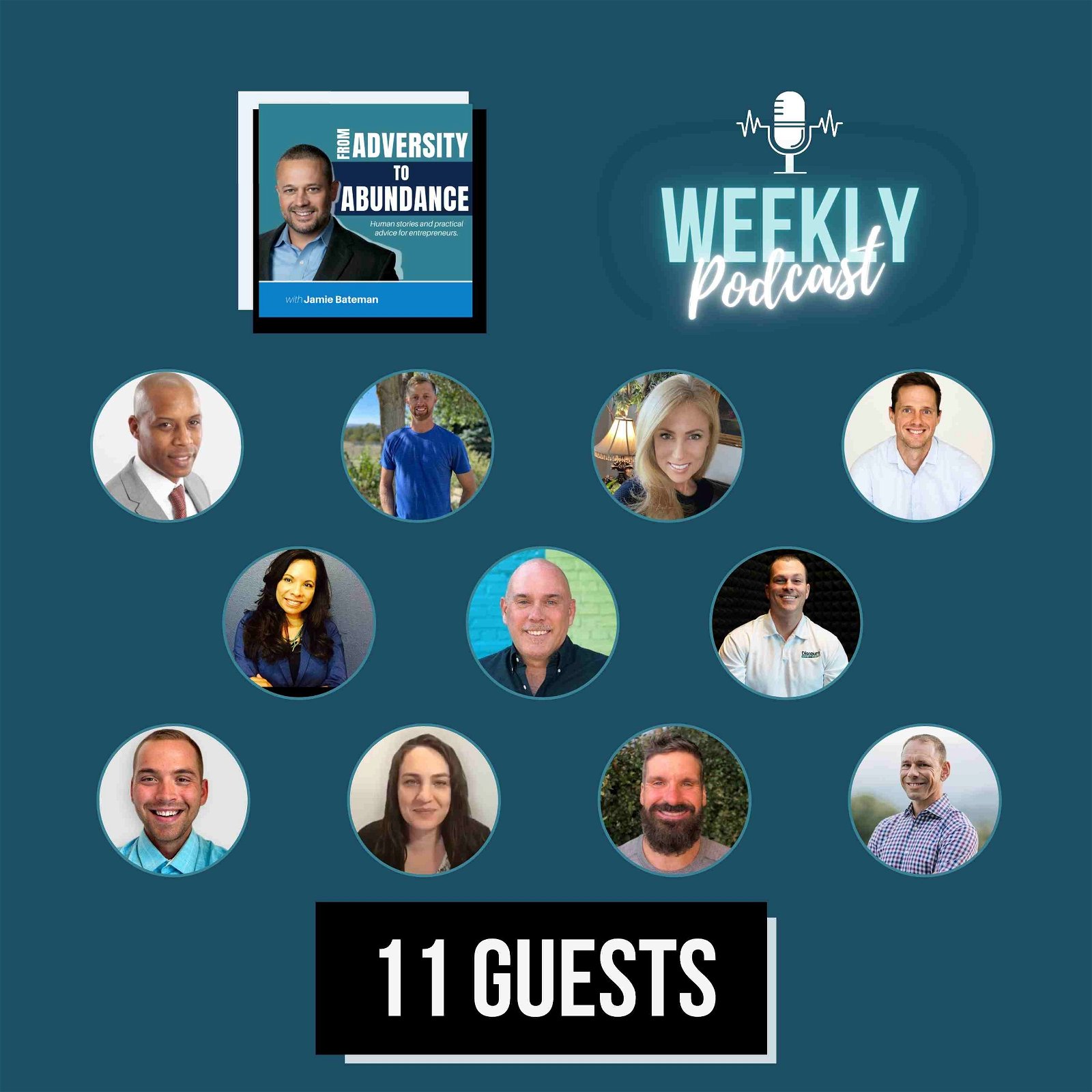
In this episode, you will hear from the 11 specials guests featured in our book, From Adversity to abundance inspiring stories of mental, physical and financial transformation. We have handpicked highlights from these guests’ stories on our podcast.
You'll hear from a diverse range of podcast guests, including Fuquan Bilal, Matt Izzo, Maricela Soberanes, Chris Larsen, Dan Haberkost, Beth Boisseau-Coots, Mark Owens, Matt Fore, David Dodge, Brent Bowers, and Emma Powell. Each guest shares their personal journey of overcoming challenges, embracing growth mindset, and finding success in various aspects of life.
Haven Financial:
https://www.myfinancialhaven.com/jamiebateman/
ATTENTION:
Unlock the secrets to a transformative life with “From Adversity to Abundance: Inspiring stories of Mental, Physical and Financial Transformation”. Buy your copy now and embark on a journey from challenges to triumphs!
AMAZON:https://www.amazon.com/dp/B0CGTWJY1D?ref_=pe_3052080_397514860
Connect with us
WEBSITE: https://www.adversity2abundance.com
Leave us a rating or review: https://www.adversity2abundance.com/reviews/new/ or here
Got comments, feedback or suggestions? We’d love to hear it! https://www.adversity2abundance.com/contact/
Follow From Adversity to Abundance Podcast
FACEBOOK: https://www.facebook.com/profile.php?id=100089126144055
INSTAGRAM: https://www.instagram.com/adversitytoabundancepodcast/
LINKEDIN: https://www.linkedin.com/company/89949391/admin/feed/posts/
YOUTUBE: https://www.youtube.com/@FromAdversity2AbundancePodcast
Connect with Jamie
BOOK:From Adversity to Abundance: Inspiring Stories of Mental, Physical, and Financial Transformation
LINKEDIN:https://www.linkedin.com/in/jamie-bateman-5359a811/
TWITTER:https://twitter.com/batemanjames
Speaker 0
Buckle up, you're in for a treat with this episode. So our book called From adversity to abundance, inspiring stories of mental, physical, and financial transformation is out, and it features eleven former podcast guests from my podcast who we hand selected, handpicked to be featured in the book. This episode that you're about to hear is a compilation of clips from those podcast episodes. So these are special guests that are featured in the book and you're gonna get four to six minutes of audio from the podcast episode where we had these these special guests on. There's a reason we handpicked these guests. There's a reason we handpicked them for this episode and the book. This one is is special. Please take a listen. I hope you love it. I hope you buy the book. Buy a copy for a friend. Share this episode. Enjoy. Speaker 1
Welcome to the from adverse today to abundance podcast. Are you an entrepreneur or aspiring entrepreneur? Then this show is for you Each week, we bring you impactful stories of real people who have overcome painful human adversity to create a life abundance. Life of abundance. You are not alone in your struggle. Join us, and you will experience the power of true stories and gain practical knowledge from founders who have turned poverty into prosperity and weakness into wealth. This podcast will encourage you through your health, relationship, and financial challenges so you can become the hero in your quest for freedom. Take ownership of the life you are destined to live. Turn your adversity into abundance. Speaker 2
For me, it was like, oh, wow. You know, I was just grateful that. I was still there. Right? So, if it was shocked, and then it was really I felt like it was it was a set up. A lot of step of things were going through my mind. So I was able to, remove myself from that element for a long period of time, and I went through a healing process. Right? I went through trust issues. I went through a whole bunch of stuff. And it really took, I would say, probably about two years for me really to understand what happened and how did it help me. Right? Because it turned me into a beast, really, with the real estate, because now that that next six months at the I got shot, I was working from home, September nine eleven happened that same year. That's September. I got shot of March, that's September nine eleven. There was all these different things that happened that just made me stronger, made me more focused, made me more grateful. You know, I would walk around and say, this person is probably not even great for that date in Tati's shoes. They can bend over Tati's shoes. It has staples in my stomach. So for this person, it's not even great for that they get to use the bathroom. This small stuff it really made me become grateful for the little things and appreciate everything. And I was just like, wow. I I never really appreciate this appreciated this smaller thing so much. Speaker 2
really put the things into perspective. So that's when I became grateful for the situation and started to use that. You know, use that energy to kinda drive me through it. Speaker 2
Same thing. Yeah. Two thousand eight came in. Speaker 0
I was spending two thousand Speaker 2
and nine money. Well, it was two million dollars of my own money and basically had to press the reset button because after that, then I got divorced and you know, that was the best thing that happened to me as well because again, the circle people that I was around was around me for the things that I had, not because of who I was. So that was a materialistic phase of my life. That I went through coming from where I was at, didn't have anything in getting into real estate, getting everything, feeling like god, you know, being materialistic, having the wrong people around you. Right? Speaker 2
Where if you're the smartest one in the room, then you know, that's the problem. So that happened where that kinda shifted where I was able to, you know, again, get out of that circle I was in. Speaker 2
And then go deeper within myself. So if from that part, you lose the money, get in divorce, you know, getting custody of my boys, trying to get rid of whatever real estate I had to survive and everything else, growing within myself, that helped me a great deal because I started getting into meditation, I started getting into a deli ritual and doing things to build up myself. Right? And that really was a game changer for me also. Speaker 2
two situations really built the foundation for for who I am today. So another situation I was grateful, even though I lost, you know, a bunch of money, really, it was really, showing me that it was more than the money because I was a slave of money. I was chasing him. Speaker 0
That's I wasn't when Speaker 2
my former wife would say, Hey, let's push the stroller and walk head to the park. I'm not doing that. That's your job. I gotta go go with these clothes and I to do this and do that. I'm getting this money. I'm paying the bills. You do that. When the reality is, you know, as we know now, families first, Right? The kids grow really fast, and you only have eighteen sounds with them. So every moment you get with them from the time they're born to know, they become teenagers and start hanging with their friends. You wanna, yeah, really, value those moments. Speaker 5
Really, what I've come to learn is that you know, obesity is, is a symptom of these deeper underlying emotional sorts of problems, right? And like it doesn't just happen in a vacuum the inside reflects the outside and the outside reflects the inside. Right? So Mhmm. Speaker 0
That's really good. Speaker 5
It's it's really hard for me to just kinda pinpoint one or two specific things that happened, right? You know, but I was just, I was in a chronically negative state is how I would describe it. But what was really challenging is is if you're in a chronically negative state, you don't necessarily realize you're in a chronically negative state, you know, much in the way the the the fish doesn't see the, you know, you know, water that it's in, right? If this is just how you experience life, Speaker 5
don't necessarily realize that, you know, this is different. You know, if you would have told me, you know, if you would have asked me what anxiety was, in in my mid twenties, I wouldn't have been able to tell you, let alone identify and say, oh, I'm I have chronic anxiety problems, right? Because that was just That was just life as I knew it. Speaker 0
That was your default. Right? Speaker 5
And and that was just how I experienced life, you know. And and I really never would have thought that a life that I'm living now, you know, with the sort of energy and the emotion that I feel on a day to day basis, I didn't even realize that something like that was possible for me But, you know, there there was always a part of me for some reason that that was optimistic, right? You know, and and I would say I was in a chronically negative state, but I always had some optimism about me, and I always kind of knew that it would, it would work out. You know, and I just, I stuck with it, you know, as best as I could. You know, there were certainly lots of adversity along the way, right? I lost the same seventy five pounds three times, right? So you know, I did it once in high school, and then I ended up gaining all the weight back again, you know, and it's it's really demoralizing to to put in all that work and put in all that effort and and reach a goal, right? And then just have it just kinda slip through your fingers and vanish, you know, and it's, it's, you feel a lot shame and embarrassment when that happens, you know, because you just you're failing so publicly. People are are seeing you and and seeing what you're going through. Right? Speaker 0
So, you know, you know, Speaker 5
these sorts of things are are are are tough to overcome and, you know, it's this is why it it took me so long to to do Speaker 5
But, you know, part of me just just never gave up and, you know, always knew that there was a way out. I just needed to to to keep trying to do better every day, you know, putting one foot in front of the other, educate myself more, you know, just just try to do more with with what energy I had at the time. And and, you know, that's This is how I got to the place where I am now. Speaker 0
Yeah. No. It's really good. I mean, it just yeah. It sounds like you you just got, like, probably a lot of people can identify with you've got on into a mental pattern of this is my default. This is who I am. This is my identity. And for those who, you know, are listening or you know, are gonna watch this on YouTube, even go back and look at at at Matt's, you know, like your Twitter or Instagram. I mean, I've seen it before and after, and it's It's like HDTV pics, you know, people love that in real estate. It's like the the before and after pictures are amazing, but they're so much work that went into that that, you know, that's easy to gloss over. So I I, I just have a ton of respect for your transformation and and and this time keeping it off. I mean, it's it's really incredible. So okay. So you lost the weight a couple times, regained it a couple times, and then and then have kept it off for coming up on five years, you said, I believe. What's been the difference this time? Speaker 5
So what I realized was I needed to make a plan, right, because I I I lost weight again in my mid twenties And I really educated myself a lot about fitness and nutrition, right? And I taught myself all this stuff, and I did it in a really intelligent way. And then I, I kind of realized I thought then at least that, okay, my problems are solved, right? I have all this knowledge now. And, you know, I didn't have this knowledge before, but now I know how to eat. I know what protein, fat, and carbohydrates are, all all this stuff. And I'm like, great. I did it My problem is solved. Well, knowledge is useless if you don't apply it. Right? So I I had the knowledge, but I stopped applying it, you know, and and I dealt with some some adversity, right, to keep in the theme of the show, had some some some more emotional trauma suffered an injury, you know, and and next thing, you know, I'm back being fat again. And, you know, it took me eight years to kind of get around to doing it again because, you know, it's, it's an overwhelming proposition. You know, you know, trying to lose a large amount of fat as I'm sure many people can can relate to. Speaker 6
There I was, you know, doing my my paying my bills and then after finishing that long shift at the hospital. And and I just got I got I got home, and I realized that Wow. The the the neighbors paying mortgage. They're paying my mortgage. That was a nice feeling to have, you know. But then I was like, and it was I was single then, and I was like, well, someday I won't be able to go to work, you know, age or anything could happen. I mean, I was making good hospital, and I was working really long hours, but I realized that if I don't go to work, I wasn't gonna be making any money. That that was, I needed to be present to make that money. Right? Speaker 6
And and I realized that someday I might not for whatever reason be able to And I saw the possibility of having the cash flow from investments, like putting the money to work, and then the money was making more money. So I figured If I do more of this, then I can fix it. Right? And so that that really was how I got started thinking about it, and and growing it up in Mexico, the duplex team wasn't a thing. You know, the we don't have duplex we either have, a house that is occupied by generations for stories, for kids, you know, but there's really no kind of investment. So I was lucky, that my my, agent, for me, because I told him I'm not looking for something big. I want a house for me, something just me. And some something else that I can, you know, have a roommate. And use the concept of the duplex duplex. So having that mentality, I thought, well, if I buy more duplexes, then I can then, you know, reduce my hours or not have gonna work. And and by looking into it. And when I deployed, I actually spent a lot of time learning on how how does that real estate can actually build your wealth and and how, you can scale it. And so that's when I learned about syndications and how you can do persons. Speaker 0
Now where where did you deploy? Speaker 6
I was in, Jabberty Africa. Speaker 0
Okay. Gotcha. I wasn't expecting that answer. Okay. Yeah. I mean, and people say, how did you have time to do that when you were deployed? And you know, I was deployed to a rack and it's even though you're busy a lot, you still have downtime, and you don't have you know, twenty four seven, you're not busy with work. So what are you gonna do with that downtime? And I actually started started a second degree because it was like, alright. I don't know. What what else would why not? And that was before remote learning was so popular. But, yeah, but two thousand six, you said, is when you got started, right, in real estate? Speaker 0
So, I mean, that's you know, the internet was obviously around, but I don't think bigger pockets was a thing. And, you know, you didn't have all these books and all these resources. So That's that's impressive. You know, because it was until much later that we really went full on with, you know, because there's podcasts and, and things staring you in the face with, how to learn and how to how to grow your network. So sounds like you did it more locally through, oh, you know, through your agent and then started to scale from there. Is that fair to say? Speaker 6
Yes. Yes. When I came back, I I have saved, a lot of money from, you know, my my my income was non flexible. And like you said, when you're deployed, they provide all your meals, everything. There's no no where you can spend the money. And, pull of that when I came back, I was looking for more duplexes. And then that, you know, at four plex came along, and I'm like, wait, My goal was to buy one one home a year, one house a year. And, and then I was like, wow, I can buy four. Speaker 4
You know, a family relationship with, a very strong emotional relationship with. The things that weren't resolved weren't resolved, not by my choice. They were Speaker 4
Because she wasn't able to deal with those and in her, you know, her situation and and that's that's unfortunate. You know, to have somebody that that goes through that. But for me, you know, having your friend, I don't think I've ever I'll ever fully recover from that. I think, and, you know, it definitely inexorably changed me because you never wanna feel that pain again. Mhmm. Speaker 4
I was pulled away from you. So you know, it it's hard to really develop deep relationships after you've been hurt so deeply. And people look, if you're listening, you know, people, whether you're in a relationship or some you break up with somebody or you're divorced or, you know, somebody dies, you know, or we wanna protect ourselves. Right? Speaker 4
So it's, you know, I think I'm I'm I'm pretty good at having relationships with doing that, but at the same time, you know, it's it's painful. And it's also hard when you experience that depth of a relationship with somebody, and it's really not possible to experience that again. What I mean is we were we were friends through high school. Speaker 4
And during very formative parts of our lives, and I won't ever be able to have that you know, that bond with somebody again. Yeah. But the flip side is I'm very grateful for the time I got to spend. Speaker 4
You know, with with all those people in my life. Speaker 0
Now I appreciate you getting vulnerable there. I mean, it's not easy to talk about and relive. And, but so, yeah, with with your friend, Chris, it's like, yeah, not only did he pass, but you you're not like you said, you're not gonna be able to replicate or duplicate that. And so there's almost like a double, you know, I don't know. It's a double hardship there. So that's that's really, really tough And again, I don't we're glossing over this. Like, it's no big deal, but it's I appreciate that. So then how did you, you started to get into it a little bit? What what did your how did you change your mindset, or how did you approach kind of the your future from there. Speaker 4
Yeah. So this is where this is where you look at kind of the, there's there's two way. I'm gonna say the first way I'm gonna say it. It it might it might sound callous, but then I'll explain. So this is where, like, the silver lining comes in. And what I mean is if you ever lost somebody, I'm sure the last thing that person wants is for you to go through the rest of your life and and and really put the brakes on anything or live less of a life because you're you're burdened by that or not having that person in in your life. Anybody that loves you wants you to go and experience life to the fullest. And a lot of my friends, Sam lucky. And I don't have to go into details, but I've had I've had some good fortune in my life. Just look things that have happened, things that are kinda unusual. And I say that's because I have a lot of people watching out for me because they want me they're looking down. They want me to be successful. And I believe that. I feel like I have a positive energy, but at the same time, I feel like it's my duty to do all these things. It's my duty to to live like this. So, you know, the the I said, you know, I said silver lining. But when you lose somebody and you realize that life is finite, especially as a young person. So, Jamie, I crossed forty one years old, and I achieved all these things in my life. And I realized my father was forty one when he died. And I know that in the back of my head, I had this this feeling of fatality that, you know, I had there was things I had to get done. So when you know that, the time value of money has I'm sorry. The, the value of time
Speaker 4
Has has time on the bottom of the equation. I'm an engineer by training. Yeah. Think of it that way. When you're young, you think you're gonna live forever. You're gonna live forever in that number on the bottom's infinity, the value zero Right?
Speaker 4
As soon as you put a value or as yes. As soon as you put an actual value on that time, whether you're gonna live ten days or ten thousand days, or, you know, fifty thousand days, whatever that number is, the value of your time goes up exponentially.
Speaker 4
And that's what I think happens subconsciously in my mind. And as soon as really once, you know, when I was an adult and Chris passed away, I thought Hang on a second. I got I got stuff to do. Like, I got stuff to do. I'm a serious person. I'm gonna get things done. And, you know, some people are like, why do you work so hard? My neighbor was like, if you don't have to work anymore, why do you still work? Yeah. Like, one, I enjoy it. And it energizes me. Yeah. And two, it's my duty. I have an impact that I'm here to make on this planet.
Speaker 7
First and foremost, yes, especially my dad. Huge warrior. The sky was always falling. The world was always ending, and the market was always crashing. Everything was going wrong all the time. And that has been extremely difficult to get out of that sort of thinking. I catch myself and I'll say, wait, no, that's your dad. That's not you. That's ridiculous. So I I still struggle with that to this day. And we can talk about some of the things that have gone wrong in business up to this point. The bit you're gonna get kicks in the teeth. I'll I'll tell you that. And the second point, what you just said is is so true because it's it's not that money itself money itself is just a concept because bartering is difficult. But it enables all of the things that matter in life. So whether it be, you know, I live out here with my brother. I've seen my family. I'll see my parents six or seven times this year, he'll see them once. Why? Cause I have money. It doesn't it doesn't really matter. I can trade that for things that matter. I can go travel. Whatever I want. So money is just a tool to trade for the things that actually matter. So when I hear people say, oh, what's more in, you know, this and that and this are more important than money? Well, somewhat misleading because money is the thing that enables all the things that matter. Speaker 0
Yeah. I love that. I mean, and it's like, you know, I equate money to it's it's like the internet. It's like, is it inherently good or bad? No. But it's ex extremely powerful. It can be very powerful. And it is. It's just a tool, and it's how you wanna use it. And I think to take the approach of money doesn't matter. Or or becoming a slave, you know, to to that fear surrounding money that you're talking about is really not not the the right way to go. Yeah. You know, it's it's easy for me to sit here and judge your parents or my parents, obviously. But I think too many people take that kind of cop out where it's like, no. I mean, I, you know, I shouldn't money isn't isn't, something to to strive for. And so, therefore, I'm just gonna, Speaker 0
know, go the easy route and and not, not try to acquire more money. But what it can do is enable things like you just talk about enable freedom, really, is what enable time freedom and and location freedom, and, like you were, like you were talking about. So, Speaker 7
Yeah. Yeah. When someone says money doesn't matter, that's very interesting. My first question would be, well, what does your week look like? When they tell me, oh, they get up, they go to work, I would, you know, respond most in most cases, it sounds like money dictates everything you do all day every day. So that's interesting because Speaker 7
You typically If you don't have it, then money controls your life. If you do have it, then you control your life. Speaker 0
That's really good. So What other obstacles or kind of themes that were were difficult for you exist existed? In other words, anything not money related, that you grew up with that was kind of challenging from a either human or a business, perspective. Speaker 7
I I would say the biggest thing that pertains to this conversation, that I would wanna get into would probably be just that intense fear based scarcity mindset. Right? Just the pen so they never figured out how to make money. So they're just super conservative with spending money and then never got to see their, you know, their parents, my grandparents, their siblings. I'm talking about my parents. That's probably the biggest one that applies to this conversation. Because it's so hard, you know, I, in hindsight, I have cut myself so short by having been stingy about marketing dollars Right? I have hiring people. Just, I have made my own life so much harder because of this. So Yeah. That's been a huge one for me, and it still is to this day. I I catch myself thinking very irrationally or worrying about things that I shouldn't worry about at all. You know? So that's probably the biggest one. And for me, self awareness has helped the most. Right? Trying to catch myself and say, hey, that's It's not you that's just, you know, twenty years of hearing your dad. Right? Sure. That has helped me a lot there.
Speaker 0
Okay. So take us from, say twenty through twenty six, just kinda bring us up to speed.
Speaker 0
did you how did you get out of that scarcity mindset, you know, or or attempt to anyway? And then get to where you are today. What were some some tools or tactics that that got you where you are?
Speaker 7
Yeah. Probably the two biggest things are just proceeding taking action in spite of being afraid and, the people you get around, I'd say are the two biggest. So I bought that duplex in college and then moved out to Colorado, bought another house hack out here, and it was around that time that I realized, hey, the the whole low and no money down thing sounds really great. It sells a lot of courses and books and podcasts, but at the end of the day, this is a cash intensive venture. You're gonna have things go wrong. If you don't have cash or or someone partnered with you who does, you're gonna get yourself hurt. You're probably not gonna last very long. So I started going to the real estate group that I now host out here. And I met a guy who had been investing in land, building houses, apartments, commercial strip centers, etcetera, for the last forty years. So I would drive an hour south every weekend and go work with him, work for him, and just learn. And that was how land and development came into the picture originally. You can really consolidating a lot of information here. But through that, I eventually just started doing it myself. And that's where front range land came about, and that has allowed me to buy more properties. So again, I, I just turned twenty six now and, and that's, what the business is at this point. Front range land feeding the investing. And I wanna tell a story about that guy. I I just mentioned.
Speaker 0
Yeah. Yeah. Go for it.
Speaker 9
I don't think I know of anyone, you know, but I'll let you know if I I can think of anybody. And she said, what about would you be interested? And I said, well, but, Glenn, I don't have a degree, and I don't have any sports experience. And she said, well, Beth, do you have a resume? And I said, no. And so she said, come over Sunday. So I did. And we cobbled together what was probably the worst history, worst resume of all time. But it got me this job, which You know, it doesn't sound like a lot now, but it in two thousand four, for me, it paid me fifty thousand dollars a year and really good benefits plus, generous commission structure.
Speaker 9
Yes. It is. So what
Speaker 0
so what had changed? I'm curious, like, why did she be I know her position changed. I think
Speaker 9
she was desperate.
Speaker 0
She must have been right.
Speaker 9
I think yeah. I do. So the first week at that job, I was just like, on cloud nine. I was like, woah. I'm in the money now. You know?
Speaker 9
it's money now. But, Right. Right.
Speaker 0
It's all relative. Right?
Speaker 9
It's all relative.
Speaker 0
you're making fifty two thousand, you said? Yeah.
Speaker 9
I know. I'm I'm the oldest of high water.
Speaker 0
But no. But, seriously, so you were making your you were for a month, you worked the receptionist job. Right?
Speaker 9
And I was at ten dollars an hour.
Speaker 0
Ten dollars an hour. Okay.
Speaker 9
Thirty seven point five hours a week.
Speaker 0
To get the health insurance? Right?
Speaker 0
Got it. And then you did that for a month or two.
Speaker 9
I did. For exactly one month.
Speaker 0
Okay. And then so, I mean, a fifty thousand dollar I mean, that is a big that is a huge jump.
Speaker 9
Well, and then the commission structure was also very good. So, you know, I have the potential of earning, you know, six figures immediately, really, or pretty pretty immediately.
Speaker 9
But it was funny because after the first week, I had this, this inspiration that, you know, oh my god. They hired a a fake, and they're gonna figure it out.
Speaker 9
And so I went to Barnes and Noble, and I bought all the books on sales I could find. And, you know, I've read about a chapter of each one. And then I started flowing door to door because it was all commercial energy. And I knew the area I lived in very well. So I I just started on a corner at an inter went door to door to businesses because it was fear, Jamie. It was absolute fear driving me. But
Speaker 0
They were gonna find find you out that you didn't know They were
Speaker 9
gonna find me out. Yeah. We have hired a fraud.
Speaker 0
Well, I've heard a lot of successful salespeople and successful entrepreneurs, business people in general who have started out with door to door sales, whether residential, commercial. Because at the end of the day, books are fine. They're great. And honestly, podcasts are great, but you're not gonna learn how to sell insurance through a podcast or how to sell, you know, commercial energy through a book you're gonna learn it
Speaker 9
by doing it. So Yeah. That's exactly right.
Speaker 9
Well, it was you know, it's one of those things when you put something out there, you know, you put this energy out there and and you have this this, drive. It doesn't always come back to you in exactly the way you think it will, but it does come back to you. I know it sounds kind of. Yeah. Woo, but, six weeks after my start date. I landed a big account that came to me from it wasn't one of the doors I knocked on, although I did get business that way. It was just I talked I had talked to one of the parents at my daughter's gymnastics facility. And she said, oh, I work for this company. I'll get you in. Maybe they'd be interested. Well, she did, and they did, and I landed the account. And so, mid October, I was the top salesperson in the state of Texas, and I remained in that position. Until I left. I was, I ended up being hired away. And, which was fortunate because unbeknownst to me at the time, the hurricane Katrina had really wiped them out. So we were they were closing their doors. So I I sort of avoided that pitfall. Got hired away. And then during at that time, my dad came to me because he realized there was somebody in the family who who had the ability to sell and said, I really need you. That that was a real fortunate Happenstance because back in the previous October, this was in March. Previous October, It turned out my ex husband had, dysplasia in his throat. And my current husband, who we were dating at the time, he had They found cancer in his finger, and it was a sarcoma. It was very aggressive. And my dad had prostate cancer.
Speaker 0
Wow. This is all at the same time. Right? Speaker 9
This was October of two thousand five. My ex husband was he had a very good prognosis. My current husband, his was dire. I mean, this it was very rare and, you know, There's like a zero percent chance of survival. It was very aggressive. He's still alive, by the way. He did survive. Speaker 0
That's I mean, I'm very thankful for that. It it's not it's interesting. I mean, you would think when you hear, oh, finger. That's no big deal. And then throw it sounds more, you know, threatening. Speaker 9
But his was just pre cancer. It was like a little key sized deal, and, they removed it and he was supposed to be fine. But He wasn't, and he didn't get better. And then around the same time my dad hired me away, he was, on disability and he could they were doing radiation, and he could only speak six whispered sentences a day, and he had had his own business. So he had, You know, it was just we had to rescind the child support agreement, do all these things. And I didn't I needed to be at home. That that was really the bottom line. So I ended up taking a pay cut so that I could go work for the family business, but be at home Speaker 9
the time, you know, because I still had young kids. Speaker 11
You, man. The, this is one of the things that I did. Anybody anybody that's listening to this, you can do this. It this isn't like magic or anything. Like, Up until this point. I and this is something that I did myself. Up until this point, when I thought about who am I, I just thought of all my failures and losses and things that I fucked up that I lied to and people that I hurt. And that's what I used to define who I am, the kind of person I am. Speaker 11
And then I decided I'm gonna, you know, sounds corny, but I'm gonna flip the script. Right? I'm gonna look at this thing, and I'm gonna sit down, and I'm gonna write down all the good things that I've ever done that I can think of. And it could be a long list. It's gonna be a short list. Speaker 0
But that's what you're gonna focus on. Right. Right. Speaker 11
that's what I did. And the first thing on the list was I quit smoking cigarettes. Speaker 0
That was the first one. Yeah. I mean, and this is when I say this, it's gonna it's gonna sound so much less dramatic, you know, but I had a similar shift kind of, you know, just I was going to work every day. Had the nine to five job with a long commute, and and that I didn't have a terrible life. I'm not saying that. Right? But I would I just kind of fell into the the trap of kind of groundhog day and that's this is what life is kinda thing. And then I I, you know, realized I started pointing to my strengths and the people in my life that, you know, that could help me and kind of just my focus changed. And so it became more about teamwork and growth and strengths and looking at the positive. And that for me was a critical piece. This was back in you know, twenty thirteen, twenty fourteen, just to start really kind of ratcheting up the real estate and note investing and things like that. But Again, not not as dramatic of a story, but but it was really important because I could have easily just gotten caught in you know, ho, what was me? This is this is my life and and that kind of thing. So the the mindset piece is critical. Speaker 11
Yeah. I don't get people don't I mean, like, people don't have to apologize like, well, you know, it wasn't that bad. Like, it's this isn't a competition. This isn't Speaker 11
you know, it's like, it's I regret all of that stuff. Speaker 11
it wasn't for that, I might not be here today. And and I've I've tilted the scales where I think I've done more good than bad now. Speaker 11
And, but I just there's some things I wanna mention that that to me are are important please. Help people to heal is, you know, like, maybe twelve years ago or so, I looked up the cop that arrested me. I looked them up on Facebook, and I found them. Speaker 11
And I sent them a message and said, hey, did you used to work in Eastern District, Baltimore City Police department. And he didn't respond. And he he's probably like, you know, uh-oh. And, And then I, you know, sent another message a couple weeks later, and I said, listen. You arrested me September eighth nineteen eighty nine. On Monument Street, corner Monument and Crescent, and you saved my life. And I just want you to know that I am truly sorry for all the shit that I ever did. And that's not how I was raised, and that's not the kind of person I am not sincerely regret all of it. And I just wanna thank you because you saved my life and I appreciate it. And, not too long after that, I got a response from him. And we're friends today. I mean, we've met. Bocked. We, you know, I've gotta I've talked to him maybe six months ago. He was number on my phone and we're friends today. And Speaker 0
so I'm kidding, was that Was that difficult? I mean, Speaker 11
for me? Yeah. Not at all, man. No. No. Because, I'm that for me is like it's it's healing for me to express, you know, to tell people how I feel like my remorse and and regret. Speaker 11
But when when the different side, I called the attorney that, like, said that life changing thing to me. Speaker 0
Yeah. He's he spoke truth into you. It was is what he's doing. Speaker 11
Right? I haven't talked to him since nineteen ninety. Listen. I mean, this is like really funny, but I called him. I he's still practicing law. He's gotta be a hundred years old. Right? And I And I I found him in the phone book and I called his office and he got on the phone. You know, the lady's like, well, is he expecting a call from you? And I was like, well, yeah, probably not. What which case is this involving? I was like, well, you know, it's a case from, like, you know, nineteen eighty nine. Speaker 11
And, she put him on the phone I just relayed the story to him. And I just told him how, you know, the comments that he made had changed my life. And this is where I'm at today. Like, you know, I have a great life. I'm a respected member of contributing member of society. I have an amazing son. Like, you know, it's like, I've got good friends, like, good people that that I hang out with. And and I just wanted him to know that that that might not have happened if he hadn't said what he had. Like, I that was like just a huge impact. Made a huge impact for me. And I didn't know it at the time, but he told me that I was actually on speaker, like, after I told him this, like his whole audience. Speaker 8
We could go into a whole whole bunch of them around Ironman, and, we were joking before the podcast. And let me just phrase that I think everybody's adversity is different. Right? For sure. To to to some of your guests on the show, I haven't had any adversity, and I'll be the first person to say that. I mean, the fact that I was born in America meant that I had to odd stacked in my favor. So I just wanna phrase that, but I because of that, I got really interested in Iron Man's because I wanted to find a way to proactively Speaker 3
find my limits and test myself and to Speaker 8
push myself out there And I like to tell people when I tell a Ironman, they're like, oh my gosh. I could never do that. How long have you been doing that? What's your time? All that kind of stuff? And I'm like, look, the the longer I do this and the faster I get, it doesn't get easier. You just get faster. And, I mean, I've been on several rides of a hundred miles where I feel like I am in tip top shape, shape, and the best shape of my life. And then you get towards the end of that ride, and you're like, man, this stinks, and I've got nothing left in the gas. I would encourage everyone out there to find little parts of their life that they can disrupt to make themselves mentally sharp and agile for those situations. And if you don't know one, I'll give you one right now. Try brushing your teeth with your left hand or your non dominant hand. Try switching the mouse over your non dominant hand. Try standing on one foot and and brushing your teeth. Like, those little actions seem small and and in the grand scheme of the adversity of the guests that you have on your show are small But there are situations and things that you can do that will better set yourself up to be resilient in those times of adversity when you have them. Speaker 0
Yeah. That's really good. Yeah, I mean, the the truth is, like, with with the show, this is, I think, my fifth episode, and what I'm finding is whether intentionally or not I'm looking around kind of measuring people's adversity and then measuring their abundance, you know, how much hardship has met foregone through, does he meet the threshold of being on my podcast? And is he in a living in an abundant life enough to to be on my podcast? You know? And it but it's the end of the day, it's like, like you said, we we all we all go through adversity. And that's the that's kind of the point of the show is everyone is is guaranteed to go through hardship, and everyone's story is going to be different. So, yes, we will compare its human nature and you know, it's we all have relative thinking. We think in a relative way, but there's but just because you, you know, haven't been shot five times like Fuquan Balal. That doesn't mean you haven't been through hardship. Yep. So, yeah. Yeah. I mean, that's I I love the I don't love that you had to go through hardship, but I love how you've reacted to it and handled it. And you you do have a growth mindset. Every time we interact, it's always like positive and, you know, inspiring interaction for me. So I appreciate that I'm just gonna fire off a few quick questions for you, and we'll see what see where it goes, and then we'll wrap it up. Speaker 0
If you could have coffee now this is like your ice cream question, I think. If you could have coffee with any historical figure, who would you choose? Speaker 8
I'm gonna give you three. Martin Luther King Junior Nelson Mandela and, Dick winners from Band Brothers. Oh, nice. Okay. Awesome. Speaker 0
I always wanted to make the joke when I listen to your show and you say dead or alive, I wanna say, I'll choose a live. I don't think, a dead person would Speaker 8
great day to help you with. You know who did mention? Let me throw a fourth in there and send Speaker 8
last name for. I get I get this opportunity to do that. Not historical, still alive. Dave Chapel. Speaker 0
Oh, nice. I think Dave Chapapel Speaker 8
is wicked wicked smart. Speaker 8
way he tells stories, the way he, sets up a joke. Like, I'm just a student of comedy. I love how people Yeah. Communicate their art form, and I think he's the best in the business by far. Speaker 0
Yeah. My my wife and I enjoy his, Netflix, you know, whenever he has a show on there. Speaker 8
And a man who had everything and out of principle said, I'm not gonna do this anymore, and then came back on his own terms to still be at the top. Like, that's Incredible. Speaker 0
That's awesome. Alright. If you were given ten million dollars tomorrow, what would you do with it? Speaker 8
Make sure my parents are taken care of. I think they are at this age in their life, but, you never know what could happen. And then I'm boring. I would probably invest it and then continue to work and do the things that Speaker 8
I would make sure that I invested it so where my, basic needs were taken care of, but I would still work. Speaker 3
Yeah, man. So I've had a lot of adversity in my in my life, and it's led me to abundance. So I can I can I'll be happy to talk about this? So you know, some of the adversity that I faced, was really more so younger in my life than it has been recently. Okay. But it has molded me and it has shaped me into the person that I am today. So, you know, I lost my I lost both of my parents before I was eighteen. I lost my mother when I was nine, and I lost my father when I was eighteen. So my dad did a great job of raising me, you know, up until I was eighteen, which I was still a child at eighteen. You know, they say you're legally an adult at eighteen, but I was I was a kid still. And, you know, so Yes. Growing up without a mother, you know, was was was difficult. It wasn't, you know, impossible by any means, but it it definitely brought some challenges. But then losing my dad at the age of eighteen was really tough because I didn't have any parental guidance. I have an older sister You know, who's always kinda had my back and kept an eye on me, but she's not my mom, she's not my dad. She's my sister. Speaker 3
And I've had other family, you know, aunts and uncles and grandparents that have obvious been there to help me and to help guide me. But at the same time, they're not your parents either. Right? Speaker 3
So at the age of eighteen, I was out on my own. And luckily, my grandparents, you know, were were, really good savers. I'm not a good saver. They were. And they were like, hey, we we would love to have you go to college. You know, we're gonna pay for it. And I was like, holy cow, this is amazing. Like, amazing people, angels on my shoulder. So they They helped me, you know, go to college for four years and help cover some of those some of those costs. I paid for a little bit of it, but they paid for the majority of it. But because I didn't have any parental guidance, man, I got in a lot of trouble in college. I just was hanging out with the wrong crowd and you know, was doing a lot of activities that we wouldn't refer to as being good activities, and, you know, a lot of these activities were were were very illegal activities. And, you know, I got myself into a lot of trouble. And, you know, at one point, I was, you know, standing in front of a judge facing seven years in prison. Speaker 3
Or certain, you know, activities that I was doing and the judge took mercy on me and was like, you know, you don't have any parental guidance. I think I was, like, twenty four at the time. Mhmm. You know, and and, you know, and I was crying up on the up on, you know, in court and, and, you know, I didn't wanna go to prison. You know? So the judge took mercy on me, though, and they in said, you know, we're not gonna send you to jail because this is your first, you know, basically big offense here. But, you know, this is real. This is real life. And if you keep you know, screwing up and and, you know, messing up, you're gonna go to jail, dude. And they ended she ended up giving me a house arrest for nine months, man. I was on house arrest for nine months because of my activities. Speaker 0
This was in in college still, you said? Speaker 3
In college is when it started, but it rolled over into, you know, into my early twenties too. Right? Speaker 3
And, but, you know, what the thing was, though, Jamie, that that was one of the best things that ever happened Speaker 3
to be honest. I mean, it's kinda crazy to think about that or to even say that out loud, but Speaker 0
No. And and just to quickly jump in, that is one of the things that, you know, we've I've it's been one of the themes with the shows we've had thus far is that, and, of course, this takes time to and reflection. Right? You don't see this in the moment. Typically, I would just I would assume. Right? But looking back, it's a lot of people have said similar things with, very painful, you know, traumatic experiences they've been through is that it is the best thing that ever happened to that. It's one Speaker 3
of the best things that's ever happened to me. Absolutely. Speaker 0
So so why do you why do you say that in your in your case? Speaker 3
Well, because if I hadn't gotten caught doing what what I was doing, I would've I would've still I would've kept doing it. Yeah. You know? So, but yeah, long story short, it was one of the best things that ever happened to me. I straightened my life out. I quit messing around with the crowd that I was messing around with. I quit messing around with the substances that landed me in that courtroom. And, you know, I realized at that point in time that You know, I had been I had been kind of veering down the wrong path since the age of about eighteen. So that was, you know, about seven years that I was, like, kind of up to no good. You know, and, Speaker 0
what were you at this point? Speaker 10
Just you know, I was I was about to turn twenty four, and my my wife at the time I really, really respected her grandpa. And I respected her mom too. Her mom was actually my real estate broker. And her grandpa said or her grandpa let me back up a little bit. Her grandpa actually introduced me to Jim Ron, not personally, but through cassette tapes. And I think I talked about Speaker 10
Well, I converted all those things from cassette to CD and would listen to these things driving down the road, and that was That's where I was introduced to personal development and started realizing life's not happening to me. It's happening for me. And another thing my, wife's grandpa said to me was join the military. Go back to school. You can do this over. Like, it's not you can you can kinda do a reset. So once again, action taker, I'm at the recruiter station at the Air Force. They wouldn't take me. Air Force would not take me. I jumped through all their hoops, a lot of their hoops, but unfortunately not high enough. And luckily, the Air Force recruiter said, hey, go next door to the military or to the army. They'll pretty much take anybody. So I'm coachable. I win next door and join the army, and I'm in basic training, like, two months later. Speaker 0
Got it. Okay. So, I mean, with everything you just breeze through, I mean, that's that's a lot of That's a big like you said, it was humbling, but touch on kinda your mindset at that point in time that when you were struggling, as far as yeah. Go ahead. Speaker 10
You know, just praying for opportunity every night and, like, to reward, like, I'll I'll I'll be a better tither, like, all these things, but Here I am sleeping in till, like, ten AM in the morning, but I was also working late. Right? That was my excuse. Oh, I'm working late, but I still could have gotten up early you know, some of the things that were ingrained in me in the military, like, now it's, like, I pretty much just wake up automatically at four AM and other I lay there in bed feeling guilty or most of the days of the week, I just get up and and get some stuff done or you know, do a bible study or read a book or or whatever, start, you know, taking action. But yeah, I mean, you know, I look back at the the person I was back then Speaker 10
And that's who needed to change. It wasn't the economy. It wasn't the dang real estate market. Everyone wants to blame two thousand eight. Way, way, way, way. Like, I bet you people I know people that absolutely freaking crushed it in two thousand. Right. And, one of those guys, I'll I'll just do a shout out right now. His name is Michael Jake. His biggest problem is all of his friends have regular jobs. And he doesn't have to Speaker 0
Yeah. So he the he can't relate to them on some level. But yeah. Gotcha. So okay. So join the military and then what? Speaker 10
So join the military and the hustler came back out that Speaker 10
Nice. I I joined as e one, and I'm tell let me tell you. My it still was not covering my bills. My e one salary. So I just had this hustle and based training. I was pulling fire guard for guys at night. I was, like, making the bunk beds in the morning. In the You're an entrepreneur already. Speaker 8
I mean, you were Speaker 0
already an entrepreneur before that, but you were using your hustler hustler skills, hustling skills in basic training. Speaker 10
Whenever graduation came, we got that one day to kinda go and celebrate with family. It had like a pocket full of cash. And I was like, okay, I'm gonna spend some of this now. Speaker 0
Did you, Did you get well, you probably didn't have they probably switched over the boots by then because we had people doing a boot shining for people. Speaker 10
There was no shining boots in my thank god, man. Yeah. Speaker 0
It was just five months to get your boots shined or something like that. But there were guys that were, like, all night long just shining boots you know, making making a lot of money. Speaker 10
Wow. Yeah. I'll tell you. And then AIT came and then we would have dressed blue inspection. Actually, it was it was our our AC or greens back then. And I would iron us for these guys on Fridays, because they would have to do an inspection to get their weekend passed. And I wasn't knowing on a weekend passes. I didn't, like, my wife lived, you know, in the next state over. Like, we weren't seeing each other very often. So I would rack up money doing that. And then It's time to move again. And, you know, just, off the Germany and basically I was stationed there for three years and then was on back to back deployment schedule and, you know, made money in on deployments. I would literally buy cartons of cigarette that I I never really told I've never told this story on Speaker 0
a podcast. Here we go, people. Speaker 12
Yeah. I'm, I'm definitely a big rock kind of person, and that goes to the analogy when you're trying to put a bunch of rocks, big rocks, small rocks and sand into a jar. If you focus on the sand first, then the big rocks won't fit. But if you put in the big rocks first, the sand will pour in. It'll fill in all of empty spaces. And so, I mean, I've heard that analogy plenty of times and it never really struck me as, you know, mind blowing when I heard it. But as time goes on, I recognize that that's just the way that I deal with life, and that's the way that I solve problems. I like to find one solution that will that will spread out or trickle down and solve a lot of other other problems. And so I would say that there's a book that I read when I started homeschooling, especially when we really switched strategies to something called unschooling where we're not doing a lot of formal education. And because like you said, six kids homeschooling, it would be too much work. It would be unsustainable. And so I'm trying to find a sustainable way to educate my children without making myself crazy. And so So finding the big rock that's gonna solve all these problems. There's this book in the unschooling community called nonviolent communication, and it was written by somebody who worked in the international community doing a lot of, negotiations, political negotiations like Jewish and Palestinian, you know, over these really borders kinds of situations. And his main premise in that book that that really hit me hard was you cannot control other people. And he didn't really say it that overtly. Speaker 12
it's like the only thing that you can help to do is communicate and you can't even make sure that they hear you. You can't even make sure that they understand you because that's what we say. We all just wanna be heard, but we can't even control whether or Speaker 12
all we can do is communicate. And then that's it. And the rest, you need to let go. And so when I started recognizing that I could categorize my life by things that I I can control and things that I can't control. That eliminated pretty much everything. Speaker 0
Yeah. That's really good. Speaker 12
So you take the situation. Let's take, my son that you mentioned. He has autism. We deal with a lot of autism. In my family and, you know, people who have autism who don't believe autism is a thing. Right? It's it's, it's been it's been fun to learn to deal with emotions and socializing and and deal with adversity and all those kind of things when when you don't quite think about things the same way that other people do. And so it's like you recognize that you can't control that situation, and there's nothing you can do about it. And so you stop worrying about it because we used to think with my son when he was growing up. Like, what did we do? How did we cause this? Like, my husband. Would would obsess over the way that he would come in and see that he was loading the dishwasher the wrong way. And he'd say, oh, wait, let's go this way and the bowls go that way. And then my son became very, very controlling and obsessive that certain things were the right way and you had to follow the rules, and this is not the way that it's done. And then my husband really thought that it was because he had these very particular ways of having him do things as a kid. And and then Speaker 0
Your husband was blaming himself. Right? Speaker 12
Blaming himself, but then we step and realize, like, we cannot control the fact that our son has autism. We did not cause this. We did not create this. And once you let that go, then you guys are focusing on, okay, how do we How do we cope? Obviously, he still has autism. But when you stop the blame game and you stop the what if game, so when you stop the what if I could control this game, you only focus in on what you can control. Speaker 12
And what we notice is most of it goes away. The other parts of it, you really can get focused in on what you can't control. And then there are a few things that you cannot control that you're still really upset about. It's really bothersome. It's really stressful. Speaker 12
And that's the stuff that we found that we need to do some more inner work on. How to not let that stuff bother you. And you have two options there. You can either expand your your circle of control or you can just learn how to stop letting it bother you. Speaker 1
Thank you for spending your most valuable resource with us. Your time. If you like the show, please share it with your friends and fellow podcast listeners. One entrepreneur at a time, we can change the world. See you next time.